
Jason Grilli knows from experience that there’s a strain placed on relief pitchers when starters have trouble logging innings. Over the course of 14 big league seasons, Grilli has spent enough time backing struggling rotations to know the toll it takes.
“It’s mentally exhausting, it’s physically exhausting, it’s emotionally exhausting,” Grilli says. “You’re sitting there going ‘we’ve got to be on and ready from the fourth inning on.’”
Rarely has that been the case for the 2016 Toronto Blue Jays. Their rotation has changed shape as the season has progressed, expanding to six starters with the addition of Francisco Liriano then contracting back to five, but along the way Toronto’s starters have consistently pitched deep into games. Blue Jays starters lead MLB with 859.2 innings pitched, and that stability has been a driving force behind the success of a team now in possession of a wild card berth.
“It’s consistency,” says pitching coach Pete Walker. “The deeper the starters get into games, the less stress on your relievers, especially with a veteran (bullpen) staff you can find a way to keep them fresh. You have a starting staff that stays healthy, that pitches every five days, typically good things happen.”
Sounds reasonable, but what exactly does that mean? Some days it’s as simple as making sure you don’t have relievers warming up unnecessarily.
“It limits the number of guys that you’re going to have to get hot down in the bullpen,” says bullpen coach Dane Johnson. “In close games like we’re normally in, within one or two, in striking distance, you’re going to have the (Joaquin) Benoits, the Grillis and the (Roberto) Osunas on the ups and downs. If they do get up you want them to pitch: he’s up, he’s hot, let’s get him in the game.”
A dozen warm-up pitches may not seem like much, but that exertion adds up, so the Blue Jays track the number of times their relievers warm up and check in with them regularly. Considering that Grilli and Benoit are 39, the Blue Jays have reason to monitor their usage carefully in the hopes that they maintain their effectiveness down the stretch.
Simply put, the more innings the rotation pitches, the less often the Blue Jays have to push their top relievers. That’s less important this time of year because expanded rosters allow for oversized bullpens, but it’s crucial for the first five months of the year.
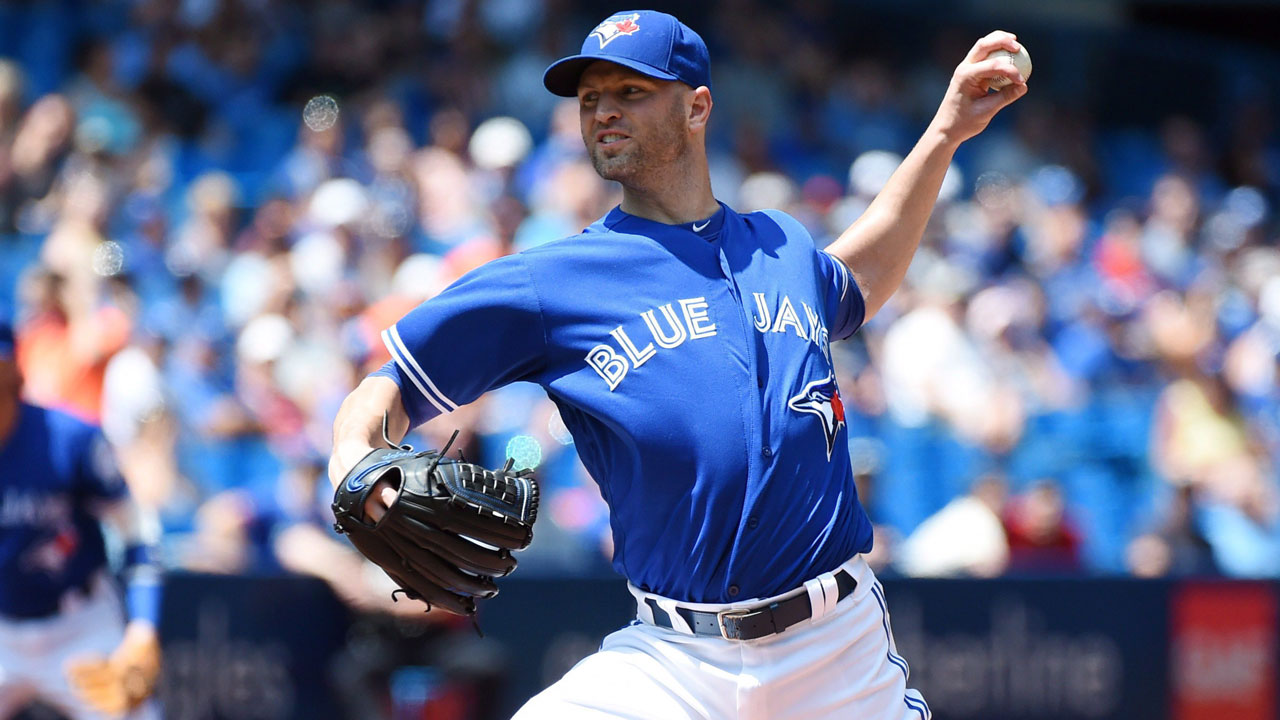
Entering the season, the Blue Jays didn’t have much reason to expect this workload from their rotation. Though R.A. Dickey had a proven ability to absorb innings, Marcus Stroman had never started more than 20 games in a season and Aaron Sanchez had started just 11 big league games. Even J.A. Happ and Marco Estrada, the Blue Jays’ veteran free agent signings, had topped out at 172 and 181 innings, respectively. Five months later, the Blue Jays have five starters on track to pitch at least 175 innings.
Still, relievers need to stay sharp, so any more than the 6.18 innings Blue Jays starters are averaging and there might not be enough relief innings to go around. That’s far from ideal for the bullpen.
To be fair, innings from the rotation aren’t necessarily predictive of or required for success. The Chicago White Sox have the sixth-most innings out of their rotation, but they’re well below .500. On the other end of the spectrum, contenders including the Baltimore Orioles, Los Angeles Dodgers and Pittsburgh Pirates are among the bottom six in baseball when it comes to rotation innings.
| Rank | Team | ERA | IP |
|---|---|---|---|
| 1 | Blue Jays | 3.81 | 859.2 |
| 2 | Cubs | 2.92 | 852.1 |
| 3 | Nationals | 3.57 | 850.1 |
| 4 | Giants | 3.82 | 841.2 |
| 5 | Red Sox | 4.22 | 838.1 |
| … | … | … | … |
| … | MLB average | 4.38 | 794 |
| … | … | … | … |
| 26 | Orioles | 4.86 | 756.2 |
| 27 | Dodgers | 4.03 | 755.1 |
| 28 | Athletics | 4.93 | 751.2 |
| 29 | Angels | 4.88 | 750 |
| 30 | Reds | 4.86 | 742.1 |
Of course the Orioles, Dodgers and Pirates have something else in common: they’ve had to search all year for consistency in their rotation. The Dodgers had to trade top prospects to acquire Rich Hill. The Orioles have a rotation ERA hovering close to 5.00. The Pirates have turned over their entire rotation since opening day.
Not exactly Plan A for any of those teams. In contrast, Blue Jays starters have provided bulk innings while also leading the AL with a 3.81 ERA.
Dickey, who’s nearing a sixth consecutive season of 30 starts, provides innings that reduce wear and tear on the bullpen. And who knows, there may even be advantages beyond the obvious.
“There’s a psychological advantage when your team goes out to play and they know that their starter’s going to be able to keep them in the game for seven innings,” Dickey says. “Confidence, number one. Two is momentum. You’re always as good as tomorrow’s starter.”
The Blue Jays have enjoyed that momentum thanks to some good health (quickest way to make a pitching coach nervous, by the way? Mention his team’s recent run of good health). Aside from some nagging back soreness for Estrada, the rotation has generally avoided injuries — a product, says Stroman, of the team’s conditioning department.
“As a staff it’s been pretty special,” Stroman says. “We’ve been able to stay healthy, for the most part, throughout the entire year and we feel like we feed off of each other. One guy pitches well, the next guy wants to out-do him.”
Most nights that means six or seven innings before asking the chance for the bullpen to do the rest. For the likes of Grilli it’s a welcome change compared to some of the volatile bullpens he’s pitched on in the past.
“The opposite is happening here where you’ve got a very good starting rotation with experience blended in with some youthful talent,” he says. “It’s a good blend.”