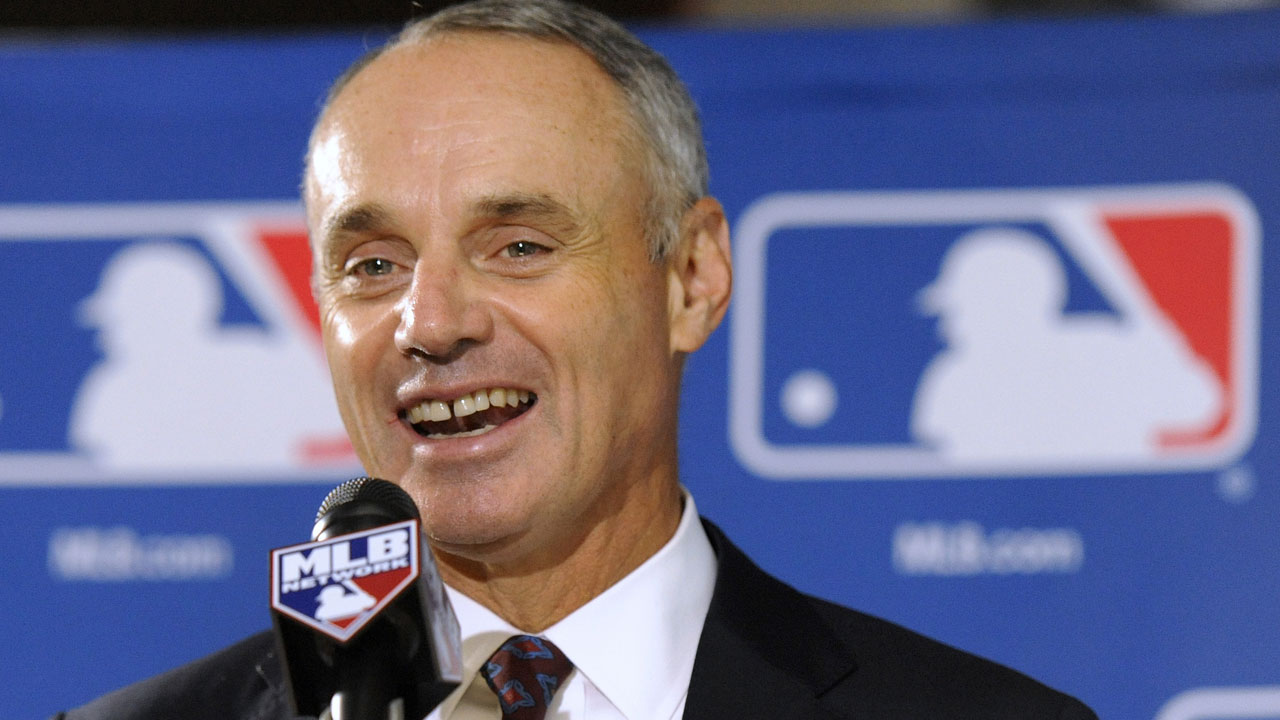

R.A. Dickey broke into the game long enough ago to understand the bitter friction that once existed between baseball’s owners and the players association. His memories of those difficult times are why he views the recent election of Rob Manfred as baseball’s next commissioner as good news for the sport.
“I think that was probably a no-brainer as far as suitors go,” the Toronto Blue Jays knuckleballer, a former player-union representative, says in a recent interview. “Although Bud Selig has been around for my whole tenure as a baseball player, and I’ve been playing professionally now for 18 years, Rob’s always been the voice. When we go to the bargaining table, when we go into meetings he’s the one that’s there.
“He’s got a good relationship with the players, he’s got a good relationship with (union head) Tony Clark and so I’m always optimistic that we’re going to stay at peace, but we’ll always have some challenges. Rob is a bright guy who wants to continue the legacy that Bud has left behind of peaceful negotiations.”
Baseball fans can only hope that’s case, although with change coming to the commissioner’s office – Manfred takes over once Selig steps down Jan. 24, 2015 – and Clark elected to replace the late Michael Weiner on a permanent basis last winter after serving in the role on an interim basis, the possibility exists that each side may want to test the other.
The current collective bargaining agreement doesn’t expire until Dec. 1, 2016 so there is plenty of time remaining for both men to fully acclimate into their roles. The players’ familiarity with Manfred, who served as baseball’s chief labour negotiator, should help maintain the carefully developed trust that’s been developed.
“I know Rob was a big part of all the negotiations in the past, and Bud leaned on him heavily,” says Dickey, who remains active in players association matters. “As a union and as players we understand that he had, I’m not going to say autonomy, but he had enough power to make big-time decisions. I think that’s helpful. When you go to the bargaining table with someone you already have experience with, it just makes it that much easier.”
Also making things easier is that while some recent disagreements have arisen between players and owners – such as the publicity surrounding the Biogenesis case and Alex Rodriguez; the actions of some teams in the draft; and how draft-pick compensation hinders qualified free agents – the over-arching conflicts of the past appear to be gone.
Unless Manfred suddenly starts, say, championing a salary cap, things will likely stay that way.
“The game is growing revenue-wise and I don’t think there are too many negatives,” says Jose Bautista, another engaged member of the players association. “There are always a couple of things that can be improved – the situation in Tampa and the situation in Oakland are the most critical, I think, that the game needs to look at, and instant replay and some of the other things. But it’s mostly little cleanup things, there are no major bargaining items, no big fights to be had, everybody is happy, everybody is making money, I don’t expect there to be any difficulty. That’s what I believe causes more problems than anything, having outstanding items that need to be fought over. I don’t think they exist right now.”
One issue that affects both players and owners is finding ways to speed up games, something that won’t come easy. Through Tuesday’s play, the Seattle Mariners were the only team in the big-leagues averaging less than three hours a game at two hours 58 minutes.
Many wild ideas exist to try and pick up the pace, and Bautista feels Manfred may be more open to all kinds of different thoughts on a number of topics.
“The trend for me to believe is that might open up some new doors for new revenue streams and more modernization of the game with having a newer, younger person in that position as opposed to Bud being a little older old school, a little on the safer side of things, not trying necessarily to be too daring or exploring too many things,” says Bautista. “With Rob also comes his team and whoever he picks to pick to assist him. I know that with an older leader and an older mentality, he’s going to have a similar group assisting him. Rob, being younger, with new thoughts and ideas, maybe his team will help with the modernization of the game, as well.”
Whichever way things do move, the players association will be closely watching how Manfred proceeds, trying to gauge what each shift means.
The union may know Manfred the chief labour negotiator, but Manfred the commissioner is a question mark.
“I feel like baseball is in a pretty good place now and I think both sides are hopefully going to work well together and not try to make a mark on the game, just grow and change as is necessary,” says closer Casey Janssen. “Whenever there is change, sometimes people try to get their stamp on things. The players association will be ready and be prepared.”