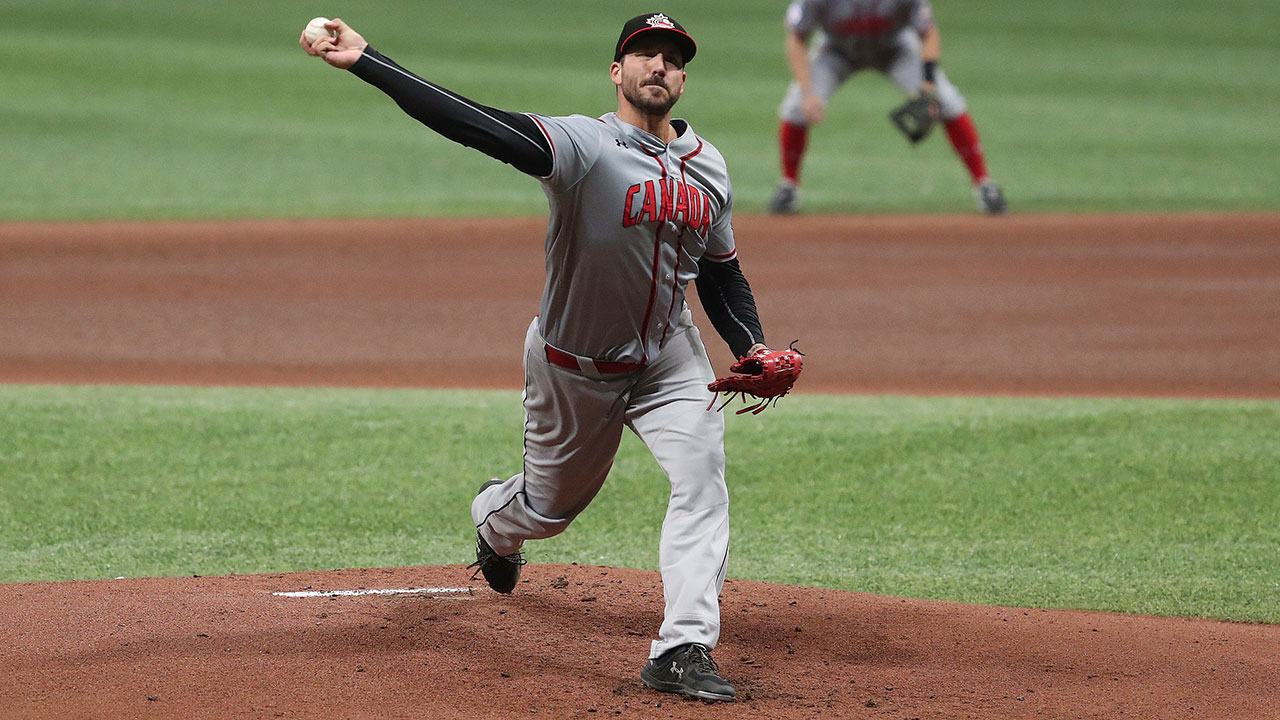

TORONTO – The routine for Clay Buchholz in the summer of 2012 included a daily dose of anti-inflammatories, a little something to help control the swelling in his body and the subsequent pain it caused, a consequence of throwing a baseball over and over again. Not a big deal, until on a couple of consecutive June days, he took his pills, ran onto the field to get his work in, returned to the clubhouse to get ready for the game and didn’t eat until the night was done.
Hospitalization and five days in the intensive-care unit followed with what his team at the time – the Boston Red Sox — said was a case of esophagitis, which is when inflammation damages the muscular tube that carries food from the mouth to the stomach. In Buchholz’s case, he says the anti-inflammatories he had ingested led to acid reflux that "ate a hole (in the lining of) my stomach," and led to internal bleeding.
"That definitely clicked the light on for me," says the Toronto Blue Jays right-hander. "I used to take them every day. I cut way down on the dosage. If something is hurt that bad that you need to manage it that way, maybe you take a start off, or two starts off. That’s how I’ve gone about it. I have a wife and three kids that are waiting for me to come home whenever I’m done with this game. That’s how I think about it now."
The ways players and teams manage pain was thrust into the spotlight Friday when a Texas coroner report revealed that the late Los Angeles Angels pitcher Tyler Skaggs died from an accidental drug overdose. A pair of opiates – fentanyl and oxycodone – were found in his system along with alcohol, a toxic mix that led him to choke on his own vomit.
Skaggs’ family issued a statement saying it was "shocked" to learn that the investigation by police in Southlake, the Dallas suburb where Skaggs was found dead July 1, "may involve an employee of the Los Angeles Angels."
"We will not rest until we learn the truth about how Tyler came into possession of these narcotics, including who supplied them," the statement added.
[snippet id=4722869]
Coping with pain in order to meet the demands of a gruelling schedule is essential for every athlete regardless of sport, but especially for one with the relentless daily grind of baseball.
One player privately estimated that of the season’s 162 games, he might feel good physically for 30 of them, perhaps 40 in a good year. Soreness typically sets in during spring training, with further aches and pains accumulating over the course of the punishing slate.
That leaves athletes, almost universally hypercompetitive and uber-motivated at the major-league level, searching for ways to stay on the field, with teams investing more and more money in sports science to help them do just that.
The most dangerous form of relief comes from opioids, narcotics that dangerously alter the brain’s perception of pain rather than healing the underlying cause. They are on Major League Baseball’s list of banned substances, but can be used if a doctor provides a Therapeutic Use Exemption.
Given their addictive nature, they are typically only prescribed to players to offer relief from acute pain immediately after a surgery, or in cases of severe injury, like a broken limb.
It’s unclear why Skaggs would have been taking narcotics, but their misuse is described by the governments in both Canada and the United States as an "opioid crisis." Addictions to and abuse of the powerful painkillers have had a devastating impact across the continent.
From 2016 through 2018 across Canada there were 11,577 apparent opioid-related deaths, according to a June report by the Public Health Agency of Canada.
Additionally, over the past 12 months in Ontario alone, there have been 2,637 Emergency Medical Services responses to opioid-related overdoses, while in 2018, 72 per cent of suspected opioid-related overdoses in the six provinces and two territories to report data occurred among men.
Opioids have legitimate medical value given their effectiveness at relieving pain, but that also creates the potential for dependence, while the feeling of being high caused by how they impact the brain can lead to abuse.
Athletes desperate to escape constant pain so they can stay on the field and perform at peak levels are particularly vulnerable, hence a reluctance to prescribe opioids unless circumstances absolutely warrant, and why police are looking into how Skaggs obtained the drugs.
"It’s a really thin line," Buchholz says of seeking pain relief. "I try not to do anything unless I really, honest to God need it. That’s the only time I ever have actually taken any pills to calm pain. I don’t like the way it affects me, I don’t like feeling groggy or down."
Non-steroidal anti-inflammatory drugs, on the other hand, are far more common since they attack inflammation in the body, which can result in pain, but as Buchholz can attest, they are not without risk either.
Still, administered carefully they can help and their levels in a player’s system can be monitored through occasional blood tests to ensure the body isn’t being overloaded. The use of some anti-inflammatories can be tapered in order to help a player get through an acute case of inflammation, while injections of cortisone, a synthetic version of the steroid naturally produced by the body’s adrenal glands known as cortisol, can be used in more extreme cases.
Ryan Tepera, Ryan Borucki and Ken Giles are three Blue Jays to have received cortisone shots this season. The first two ended up having surgery to alleviate their issues, while Giles has returned to form since receiving his injection at the end of July.
Less invasive treatments to ease the physical burden on players include massage therapy, hot and cold tubs and electrical stimulation units.
Buchholz makes use of all of them, along with a dose of anti-inflammatories, "usually the night before I pitch, and after I pitch, and go from there. If it ever got to a point where I was hurting, I’m not going to do the team any good by going out there, so that’s when I would say that something’s hurt."
As long as that’s the case, "I try to gut it out and not even use them," he adds. "It’s not like your body feels the same every day when you come in. My body could feel really good one day and then wake up the next day and something isn’t right. You have to find ways to manage that and get through it. Sometimes it’s tough because you’re going up against the best competition in the world. You’d much rather win than lose and it’s not fun going out there and not looking good. That’s a risk everyone is willing to take in this game because we’re one of 750 in the world getting to do it at the time.
"I’ve been through a lot, played through a lot and it’s been awesome. I’m blessed and fortunate to get do what I get to do. That’s why I’m going to do it for as long as I can, because when it’s over, it’s over, you’re not going to get to come back."
[relatedlinks]