All it took was a walk-off home run from Max Muncy to end the longest game in World Series history.
By the time that Muncy took Nathan Eovaldi deep, more than 500 pitches had been thrown during 18 innings of baseball over the course of seven-plus hours between the Los Angeles Dodgers and Boston Red Sox. Forty-five players had taken the field including David Price in relief and Clayton Kershaw as a pinch-hitter. Along the way, there were plenty more memorable moments.
Here are some observations on an epic Game 3 that cuts Boston’s series lead to 2-1…
EOVALDI DOES HIS BEST
After a game that long, both pitching staffs are in disarray.
Price was one of four starting pitchers the Red Sox used Friday, but it was Eovaldi who took on the biggest workload of all. The right-hander was near-perfect over six-plus innings before allowing the Muncy homer, throwing 97 pitches and touching 101 m.p.h. on the radar gun. Including this latest effort, he has now pitched in all three World Series games.
Eovaldi had been slated to start Game 4, but that’s no longer possible, so it’s unclear who will start Game 4 Saturday opposite Rich Hill. Red Sox manager Alex Cora has a few options at his disposal, including Drew Pomeranz, Eduardo Rodriguez, a bullpen game, or even Chris Sale on short rest.
Both closers pitched extensively with Craig Kimbrel throwing 28 pitches and Kenley Jansen throwing 32. Pitching on one day of rest, Price got two ninth-inning outs, reaching 95 m.p.h. three times after doing so just 14 times during the entire regular season.
[relatedlinks]
EVERY BASE MATTERS
The Dodgers wouldn’t have tied the score in the 13th inning without some heads-up baserunning from Muncy. When a foul pop-up forced third baseman Eduardo Nunez into the stands, Muncy advanced to second, setting up the Yasiel Puig infield single that forced a throwing error from Ian Kinsler and allowed Muncy to tie the score 2-2.
BRADLEY JR. PLAYS… AND STEPS UP
Once the series shifted to Los Angeles, Cora had to decide how to get J.D. Martinez’s 43-homer bat into the lineup under National League rules.
In theory, the Red Sox could have asked Mookie Betts to play second base, a position he barely played in 2018, or benched Jackie Bradley Jr., perhaps their best defensive outfielder. Instead they played Martinez over Andrew Benintendi, another strong defender who posted an .830 OPS in 2018.
The decision to keep Bradley Jr. in the lineup paid off in the eighth inning. The Red Sox hadn’t been able to generate any offence whatsoever until that point, and Jansen was on in search of a two-inning save until Bradley Jr. took him deep for a game-tying home run that rewarded his manager’s confidence.
Bradley Jr. has now driven in 10 runs during the post-season, all of them with two outs. Martinez, meanwhile, handled left field reasonably well despite having rolled his ankle running the bases in Boston.
THE THROW
The fly ball Nunez hit to centre field in the top of the 10th inning would normally be deep enough to score Kinsler from third and give Boston a 2-1 lead. Cody Bellinger had other ideas, however. The centre-fielder, who had been picked off of first base the previous inning, unleashed a perfect throw home to double Kinsler up and keep the game tied.
Remarkably, centre field hasn’t even been the 23-year-old’s primary position at the MLB level. He has played more first than centre on a deep Dodgers team despite exceptional speed and a strong throwing arm.
BUEHLER THE ACE
Martinez likes hitting fastballs. Objectively speaking, he’s one of the best in the world at it, and has been for quite some time.
In that context, Walker Buehler’s fourth-inning approach against Martinez merits a closer look. Here’s how the at-bat unfolded:
Pitch 1: 99-m.p.h. fastball on the outside corner, called strike
Pitch 2: 98-m.p.h. fastball up and in, ball
Pitch 3: 97-m.p.h. fastball above the zone, swing and miss
Pitch 4: 99-m.p.h. fastball on the inside corner, called strike
Not many pitchers would even attempt that approach against an MVP candidate like Martinez. Fewer still get away with it. But Buehler, a rookie who’s just 23 starts into his major-league career, had frontline stuff working Friday. Three innings later, he would strike Martinez out a second time with his final pitch of the game, another 99-m.p.h. fastball.
Buehler became just the second pitcher to throw a quality start against Boston this October, joining Justin Verlander. He struck out seven over seven scoreless innings Friday, allowing just two hits while throwing a season-high 108 pitches.
So even though Clayton Kershaw remains the ace of the Dodgers’ staff because of his experience and pitching savvy, it’s the 24-year-old Buehler who has the most impressive arm. As Adam Wainwright wrote Friday, “best stuff I saw in person all year from a starting pitcher.”
MANNY BEING MANNY
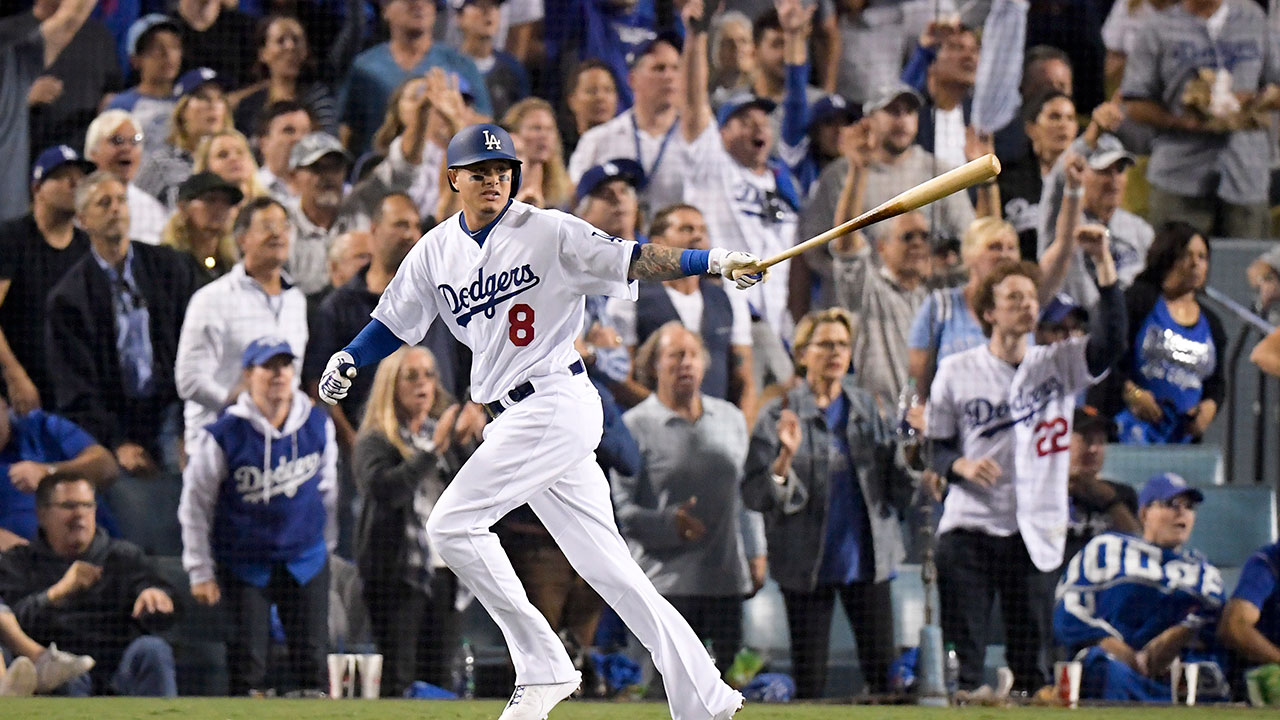
With two outs in the bottom of the sixth inning, Manny Machado hit a ball deep to left field. That’s nothing unusual considering that Machado’s an exceptional hitter who often makes hard contact, but what happened next offered another telling glimpse at a player on the brink of free agency.
The fly ball was hit hard – 105.6 m.p.h, to be precise – and at first glance it had a chance to leave the park. After making contact, Machado started trotting slowly toward first base only to see the ball hit the left-field wall. By the time Martinez retrieved it, it was too late for Machado to advance beyond first base.
Earlier in the playoffs, Machado said hustling wasn’t his ‘cup of tea.’ This play proved as much – even when the stakes are highest.
THE LEFTIES RETURN
Because Sale and Price started the first two games of the World Series, the Dodgers went all-in on right-handed batters at Fenway Park. That meant left-handed hitters Muncy, Bellinger and Joc Pederson – Los Angeles’s top three home run hitters – all began the first two games on the bench before entering as pinch-hitters.
With right-hander Rick Porcello on the mound for Game 3, the Dodgers finally got the chance to start their left-handed power and it paid off early. Pederson got the scoring started by hitting a poorly-located change-up down the right-field line for a third-inning home run.