Love him or hate him (or be indifferent — the choice is yours!), there’s no question that Kobe Bryant is a basketball savant. Like any all-time great, his ability to read and analyze the minutiae on any given possession gave him a distinct edge throughout his career.
Bryant is back (sort of) with a new ESPN show, Detail, which offers a no-nonsense breakdown of the 2018 NBA playoffs.
In his latest episode, Bryant dissects DeMar DeRozan‘s performance in Game 1 of the Toronto Raptors‘ first-round series versus the Washington Wizards. DeRozan finished with 17 points and six assists while the Raptors won 114-106.
Bryant focuses mainly on possessions in which DeRozan is the primary ball handler, assessing the different reads, successful possessions, and missed opportunities when the Raptors all-star has the ball in his hands.
Here are some takeaways from Bryant’s film session on DeRozan and the Raptors:
Finding easier scoring opportunities

Here Bryant shows us a screen-and-roll play in which Jonas Valanciunas sets a screen for DeRozan and rolls to the basket. The Wizards defence collapses on DeRozan, with two defenders left mobbing him and a third hovering nearby.
On the play DeRozan jumps and fires an overhead pass to the corner for Serge Ibaka, who then feeds the ball inside to Valanciunas, setting up a one-on-one opportunity for the Raptors big man down low against Wizards centre Marcin Gortat. “Those cross-court passes are so easy for [the defence] to rotate to,” Bryant explains.
With that in mind, Bryant points out, DeRozan has better options once Valanciunas rolls. With Washington’s Bradley Beal having to cover both OG Anunoby in the right corner and be the help defender on Valanciunas down low the best option, Bryant says, would be for DeRozan to fire a pass to the big man, setting up either an easy (read: open) layup or allow Valanciunas to pass the ball to a wide-open Anunoby in the right corner.
Bryant highlights multiple possessions like this in which the Wizards — intentionally or not — allow Valanciunas to roll freely, providing him plenty of opportunities to make passing plays out of the post.
Screening with intent

Pay close attention to Ibaka, who is setting a lackadaisical screen on DeRozan’s defender, Otto Porter. Ibaka barely makes contact with Porter, who dodges the pick and runs under it with ease.
“No,” Bryant says disapprovingly, “that’s not going to do.”
It’s one of a few times that Bryant takes issue with the way the Raptors big men screen for the ball handler. As he puts it, the Raptors have to be more physical setting their screens, and ball handlers like DeRozan need to use more of them to fire quick shots that will leave the defence second-guessing on future possessions.
“These are screens [designed] to simply get open to get the ball,” he says. “They should be screens that carry a threat. You should worry about me shooting once I get the ball.” In Bryant’s assessment, Ibaka is just going through the motions on a set play. Ibaka knows he is going to sag to the three-point line after setting the screen, and because he executes his part so casually, the defence has an opportunity to relax and hone in on DeRozan.
Ibaka had a strong performance in Game 1, scoring 23 points while grabbing 12 boards and swatting a pair of shots. But there’s always room for improvement, especially when it comes to the finer points of the game.
Backdoor man
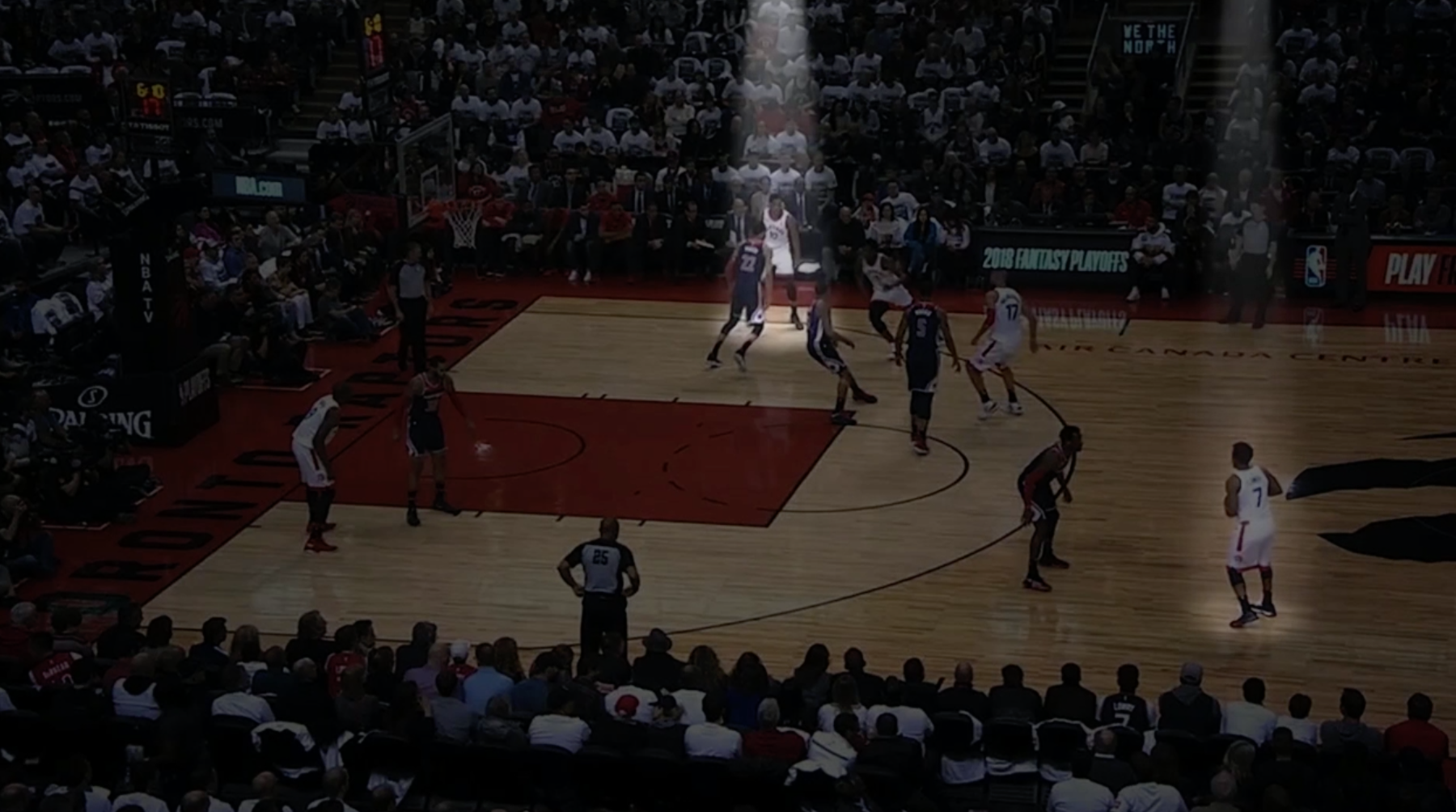
Part of what made Bryant such a lethal offensive player was his ability to pick up — in real time — the most subtle indicators from defenders. In this example, Bryant points out that Porter (guarding DeRozan near the right corner) is leaning slightly right, his momentum carrying him toward the top of the key, where he is expecting DeRozan to go.
It’s a perfect backdoor cut opportunity for DeRozan, who would be in good position to catch a lob pass at the rim from Lowry. Instead, DeRozan went to the top of the wing, caught a pass from Lowry, used a quick Valanciunas screen, and when there wasn’t room to drive to the hoop, stepped back for a corner three. DeRozan ultimately got a decent look at a makeable shot, but to Bryant’s point, missed out on an even easier opportunity.

Again looking at how DeRozan can help create easy opportunities for Valanciunas with his passing, Bryant points to this play as an obvious scenario in which DeRozan, after executing another screen-and-roll with his big man, can throw an easy lob over top the Wizards defenders and into the waiting hands of Valanciunas for an open dunk — especially considering that Washington’s nearest help defender, John Wall, is preoccupied by making sure he doesn’t lose Lowry beyond the arc.
Instead, DeRozan drives through the three defenders and draws a reach-in foul en route to the rim. A fine result, but, again, one that comes at the expense of a better one.
Learn from a legend
One of Bryant’s most consistent points when it comes to DeRozan’s decision-making with the ball in his hands is that the Raptors all-star tends to hold the ball for too long awaiting an opportunity to pass or score depending on how the defence reacts.
He compares a number of DeRozan’s possessions to highlights from Steve Nash’s career. We see DeRozan hold the ball in scenarios in which we see Nash quick to make a pass and capitalize on even the slightest defensive lapse.
Bryant acknowledges that it may not be the most fair comparison to make for DeRozan, asking him to make plays on the same level as one of the greatest playmakers of all-time. But his point is that those opportunities are there for DeRozan if he keeps his dribble alive for longer, and is less deliberate with his decision-making.
“On the surface, yes, we’re absolutely different players,” Bryant says, taking on DeRozan’s point-of-view, “but our ability to command double- and triple-teams is exactly the same.”
Posting up
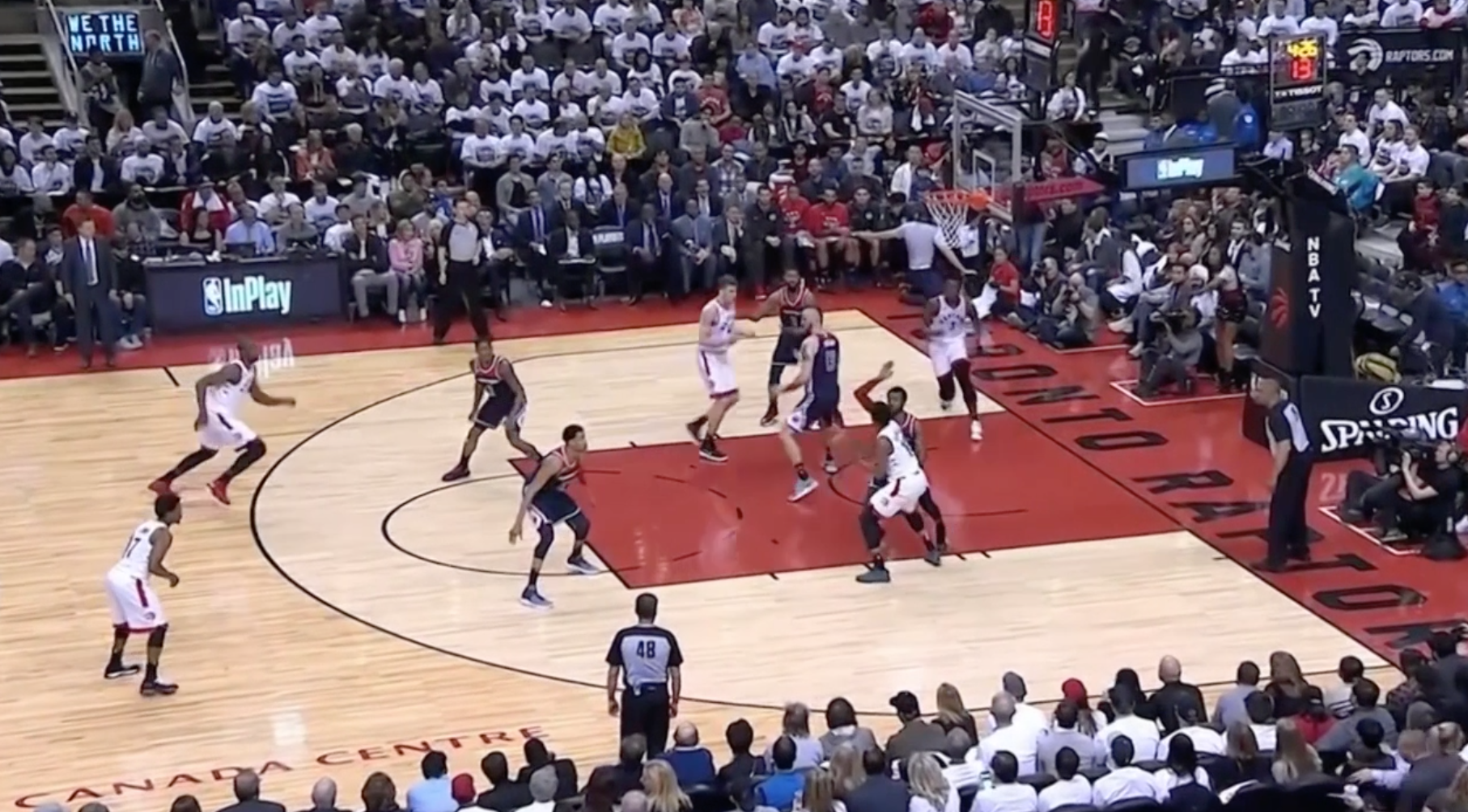
“I don’t know why it took [DeRozan] so long to get to the post,” Bryant says while breaking down this play, in which we see DeRozan about to pass it to Anunoby under the hoop in the image above. DeRozan has long been a matchup nightmare once he posts up because of his ability to hit a turnaround jumper or use his next-level footwork to create shot opportunities underneath the basket. But as this has been established in scouting reports and DeRozan’s game has expanded, his passing ability out of the post is an effective weapon for the Raptors.
On this possession DeRozan gets into the paint, posts up his defender, and finds an open Anunoby cutting the baseline. The Raptors rookie corrals the pass and finishes with an easy two-handed reverse dunk.
Throughout the episode Bryant praises Anunoby for sneaking along the baseline on countless possessions, setting him up for opportunities just like this one. It can be an area the Raptors exploit more often in Game 2, or one that the Wizards recognize and adjust their defensive rotations accordingly.
It’s just one of the countless adjustments both teams will look to make ahead of Game 2, which tips off Tuesday night.
[relatedlinks]