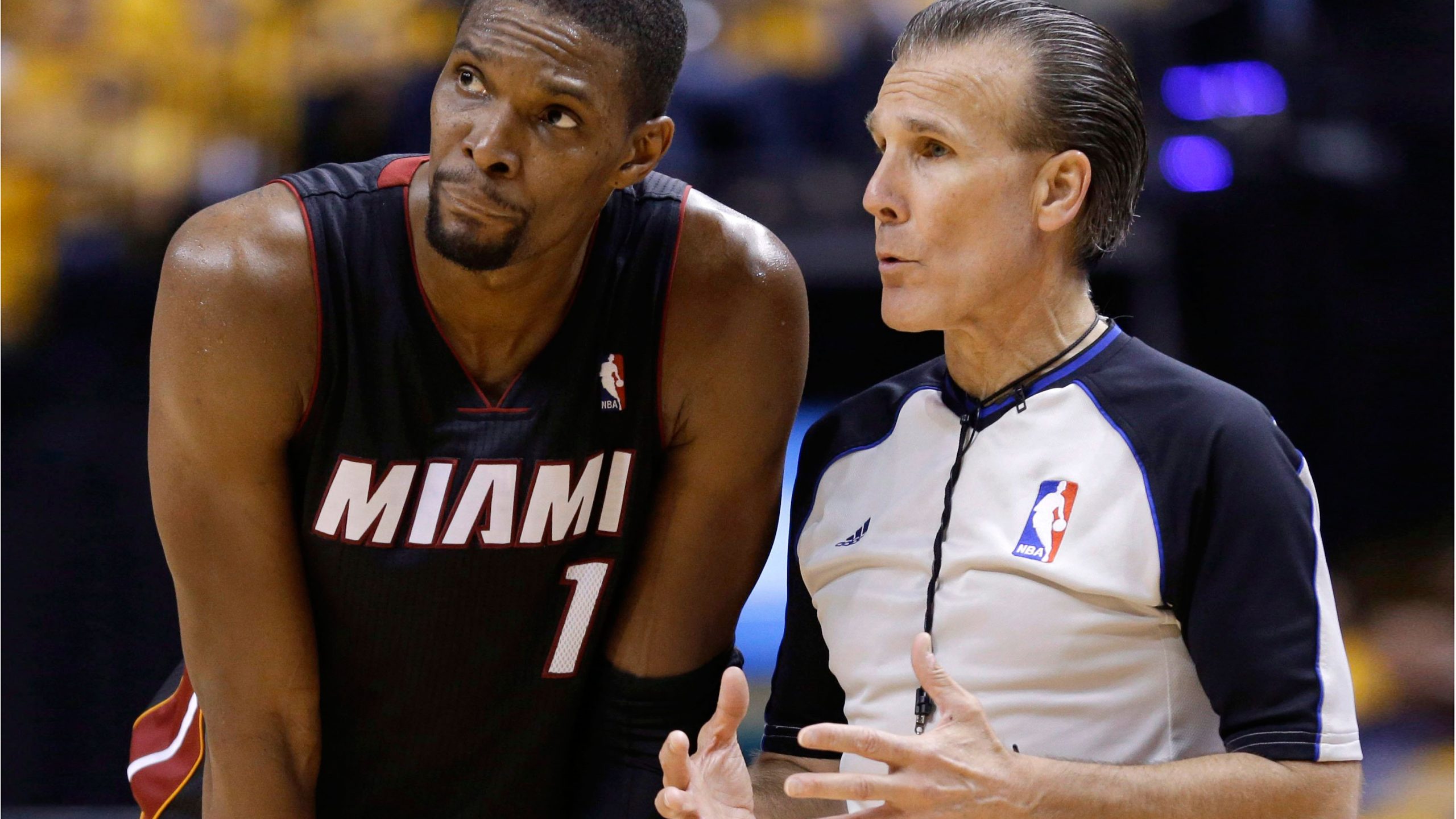

LeBron James’s Game 5 foul trouble threw NBA officials under the microscope for what seems like the millionth time in this post-season alone. I have always maintained that NBA officials have the most difficult adjudicating job in any of the four major sports (or any sport for that matter) and the challenge only begins with the fact that there are judgments to be made more consistently that any other game. Factor in the entertainment quotient and the fact that basketball is the only game where a limited number of common infractions can get a player banished, and the pressure on the officials—particularly in the playoffs—is immense.
People pay big money to sit courtside. Can you imagine paying $3000 to sit courtside and watch Kobe Bryant or LeBron James only to have him foul out? The league is, of course, mindful of that and—Game 5 excepted to a certain degree—it leads to high-profile players and teams seeming to belong to a different circle than the rest of the NBA; one that gets the benefit of the whistle in close games, while the “bad” circle of teams doesn’t, always “finding ways to lose” because “that’s what they do.”
So, how does a team or player move from the bad circle to the good one? They keep their heads down, play harder and establish that workmanlike approach as their recognized style of play. In time, if they start winning, they may be able to slowly change the perception and start to get calls. Raptors fans need only look at DeMar DeRozan, who in his fifth season finished in the top 10 in average free-throw attempts per game—ahead of big names like LeBron James, Carmelo Anthony, Russell Westbrook, Paul George and Chris Paul.
Video review has helped ease the pressure on officials, removing some of those on-the-fly judgment calls. So why not consider further rule changes intended to make the game more equitable?
How about this one? Should a player actually foul out of a game or should the NBA consider the old Continental Basketball Association rule (already adopted in the summer league) that allowed a player to stay on the floor after their sixth foul? After the sixth, every additional foul results in the opposing team getting one free throw and possession.
That would take some of the pressure off the referees. They would no longer have to worry about banishing a high profile player from the game. It’s no secret that stars rarely foul out—some career foul-out numbers: LeBron James 4, Chris Paul 5, Dwyane Wade 7, and Tim Duncan 17—why not institute a rule to make that fact less inequitable?
Put the pressure on the coaches—rather than the officials—to decide whether a given player is worthy of remaining on the floor. After fouls seven and eight, where the penalty is one shot and possession, make it two and the ball for the eighth and ninth fouls. Following the tenth, it’s three shots and the ball.
I can hear some of you now asking, “What if a player is left in the game to be a hacker?”
That wouldn’t happen if certain provisions were built in. For instance, if a team trails on a player’s sixth foul and there are fewer minutes left on the game clock than the number of two-point field goals needed to tie the game, that player must leave the floor. So if a player gets his sixth foul with four minutes to go and his team trails by 10 points (five two-point buckets), he’s gone. If his team cuts the lead to four points (two conventional baskets) with three minutes remaining he can re-enter.
The specifics of the rule would obviously need discussion and tweaking, and it wouldn’t completely eliminate the impact of the officials’ judgment in the assessment of a foul, but it would hopefully alleviate some of the perceived inequities in officiating.