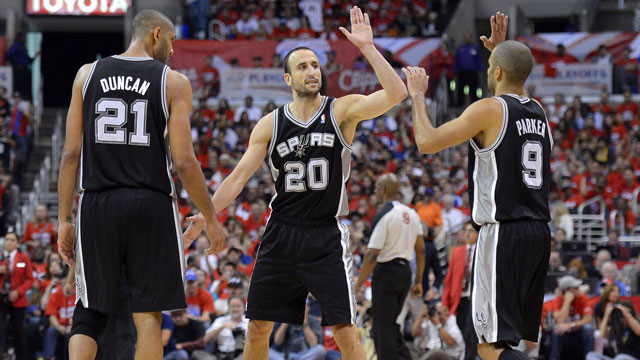

When talking about all-time NBA trios, the Los Angeles Lakers’ Magic Johnson-Kareem Abdul-Jabbar-Michael Cooper combo, the Boston Celtics’ Larry Bird-Kevin McHale-Robert Parrish and, most recently, the Miami Heat’s LeBron James, Dwyane Wade and Chris Bosh all get mentioned as the cream of the crop.
But are they really?
The San Antonio Spurs’ triple threat of Tim Duncan, Tony Parker and Manu Ginobili surpassed Magic, Kareem and Cooper for the most playoff wins ever by an NBA trio on Wednesday, picking up post-season W No. 111 and possibly shooting to the top of the list of the best three-man units in league history.
When you break it down, Duncan-Parker-Ginobili almost completely eclipse the other threesomes at the top of this page.
In addition to the most post-season wins, the Spurs’ combo has just as many championships (three) as Bird-McHale-Parrish and one more than James-Wade-Bosh. Only Magic-Kareem-Cooper have more rings together than the Spurs’ trio, but with how much tougher the Western Conference is now compared to the 1980s, San Antonio’s run could be considered just as impressive.
So is Duncan-Parker-Ginobili the best NBA trio ever? When you take into consideration that Duncan is the greatest power forward and a top-five big man and the fact that all three have continually re-invented themselves to stay at the top of the mountain despite the amount of wear-and-tear they’ve all suffered, they just might be.
Thunder(small)ball
The 2014 Western Conference final hasn’t been the most enjoyable experience for the Oklahoma City Thunder, with Kevin Durant and Russell Westbrook both struggling and the Spurs eviscerating OKC’s interior D with rim protector Serge Ibaka out for the post-season.
The Spurs have played picture-perfect basketball so far and even if Ibaka was playing, it’s likely that San Antonio would be seeing similar levels of success on the inside. But life without Ibaka has been undeniably hard for OKC coach Scott Brooks, who’s experimented with a number of lineups, including going big and defensively focused with Steven Adams and Kendrick Perkins on the floor and a small set with Durant at power forward.
Brooks hasn’t found much success in any combination, but flip-flopping the looks certainly hasn’t helped matters.
For the Thunder to have any success in the series Brooks needs to find a lineup combination and stick with it. Seeing as OKC simply can’t stop the Spurs’ interior assault, they may as well concede the inside and go with a smaller, quicker lineup that can knock down shots and ensure Danny Green doesn’t end up going off for 21 points on seven made triples a second time.
The defensive hit the Thunder will take by playing smaller may seem like too great a risk, but Perkins, Adams and Nick Collison aren’t stopping anybody, so spreading the floor to allow better driving lanes for Durant and Westbrook appears to be the best solution to a problem with no sure answer.
The odds are stacked against the Thunder as teams have gone onto lose a best-of-seven NBA playoff series 94 percent of the time after going down 0-2. However, in 2012 OKC contributed to that six percent success rate, and while that team had both Ibaka and James Harden and didn’t lose nearly as badly in the first two contests, to completely count the Thunder out at this juncture would be a little foolish.