Fresh off his most productive night in a Toronto Raptors uniform, it’s hard to ignore what Serge Ibaka has been doing early this season.
Yes, Sunday night’s performance was an anomaly — of all the wild achievements Ibaka had, perhaps the most jaw-dropping is that he became the first player since WILT CHAMBERLAIN to make 18 consecutive shots, dating back to the Raptors’ win in Phoenix last Friday.
Historical context aside, his career scoring night — 34 points in the Raptors’ 121-107 win against the Los Angeles Lakers — put an exclamation point on what has been the best start to any of his 10 seasons in the NBA.
Bolstered by Sunday night’s explosion, Ibaka is currently shooting 57 per cent from the floor and averaging 18.1 points per game — also a career-high — while grabbing more rebounds per game (7.6) than he has in four seasons. All of this while playing 27 minutes per game, which is below his career average. His offensive rating of 116.5 is by far the best of his career, while his defensive rating of 100.2 is Ibaka’s best since the 2012-13 season.
So what’s different? The biggest change has obviously been Ibaka’s positional shift to playing full-time centre under Nick Nurse, a move that has lifted the Raptors’ ceiling on both ends of the floor.
The early results speak for themselves. Through 10 games now the Raptors’ net rating is an impressive 16.3 with Ibaka on the court, and -1.1 when he’s riding the bench. Offensively, the Raptors’ rating jumps from 106 with him off the court to 116 with him on it — higher is better. In terms of defensive rating, where the lower the number the better, the team’s rating goes from 107 when he sits to 100 when he’s playing.
Shooting
One of the more noticeable changes has come in his shot selection, a combination of where coaches are placing him on the floor and a conscious effort on Ibaka’s part to be a more efficient offensive weapon.
Just take a look at his shot chart thus far this season. What immediately stands out are the amount of shots taken — and made — near the hoop:
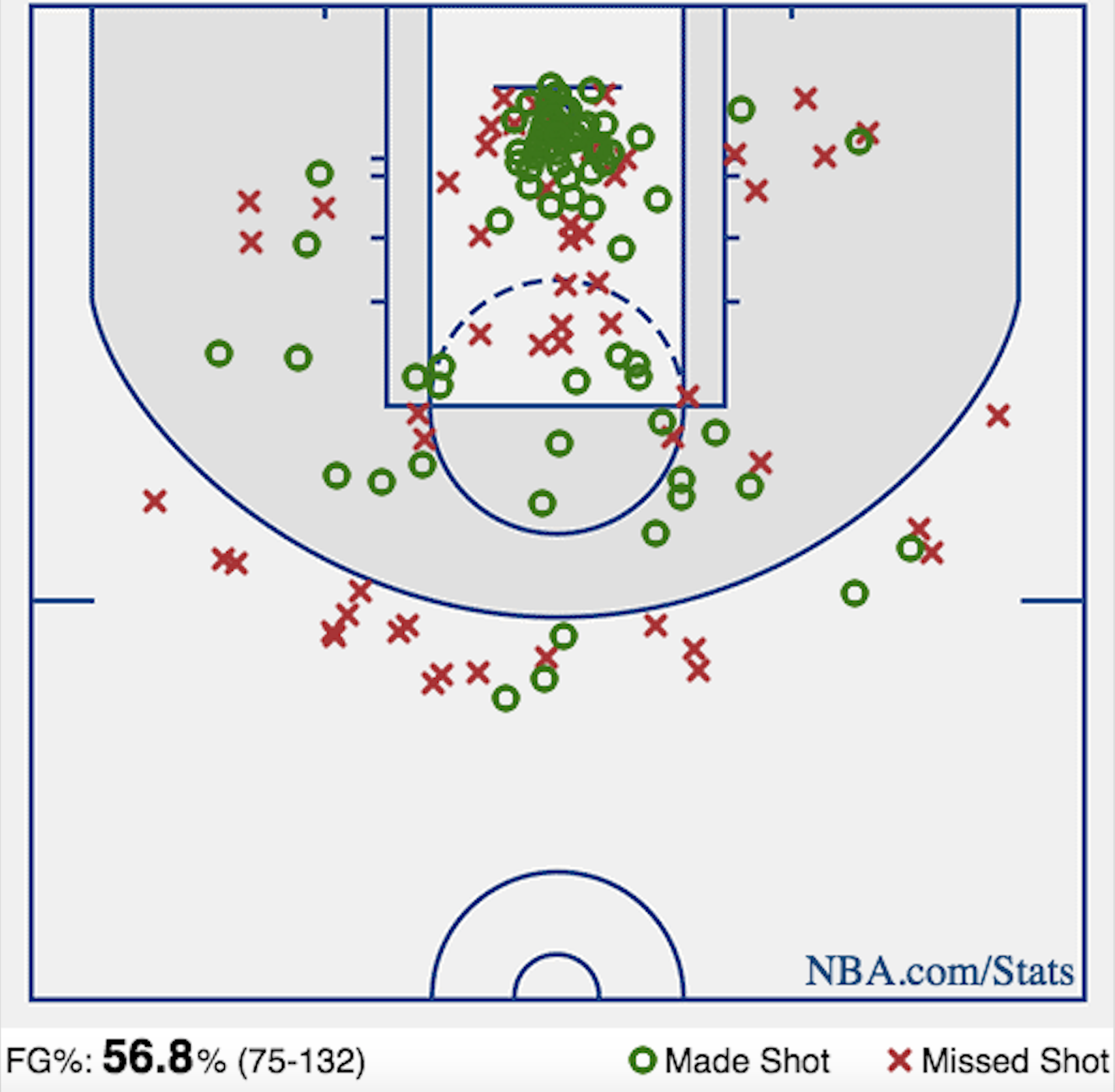
That alone is a fairly significant departure from how Ibaka manufactured his points during his previous season and a half in Toronto.
This season, half of Ibaka’s field-goal attempts (49.2 per cent to be specific) have come from within 10 feet of the hoop, compared to just 29.6 per cent last season. Working in the flow of the Raptors offence, he’s wisely strayed away from shooting pull-up jumpers, which accounted for nearly 15 per cent of his shot attempts last season and is cut in half.
The move to centre simplifies things on that end of the floor, and Nurse says it’s easier to be effective offensively playing at the five versus power forward, where Ibaka spent the vast majority of his minutes under Dwane Casey.
It’s not exactly rocket science. Under Nurse’s offence, Ibaka is generally asked to do less and is more often put in a position to succeed. Without Jonas Valanciunas alongside him — the two shared the court for the majority of last season — there is obviously more space around the basket for Ibaka to operate, and a mandate to get the big man the ball in the paint.
Roll play
As the roll man, he naturally gravitates toward the basket, giving him chances for layups, uncontested dunks, short jumpers, or other makable opportunities. Last season on a play like this Ibaka would have likely hovered around the three-point line for a potential catch-and-shoot look, or set an off-ball screen to try to create space for a teammate. But in a common sequence like the one shown below, he sets the screen, and makes a bee-line to the hoop where he’s wide open, eventually hitting a smooth turnaround jumper over a late-arriving Karl-Anthony Towns.
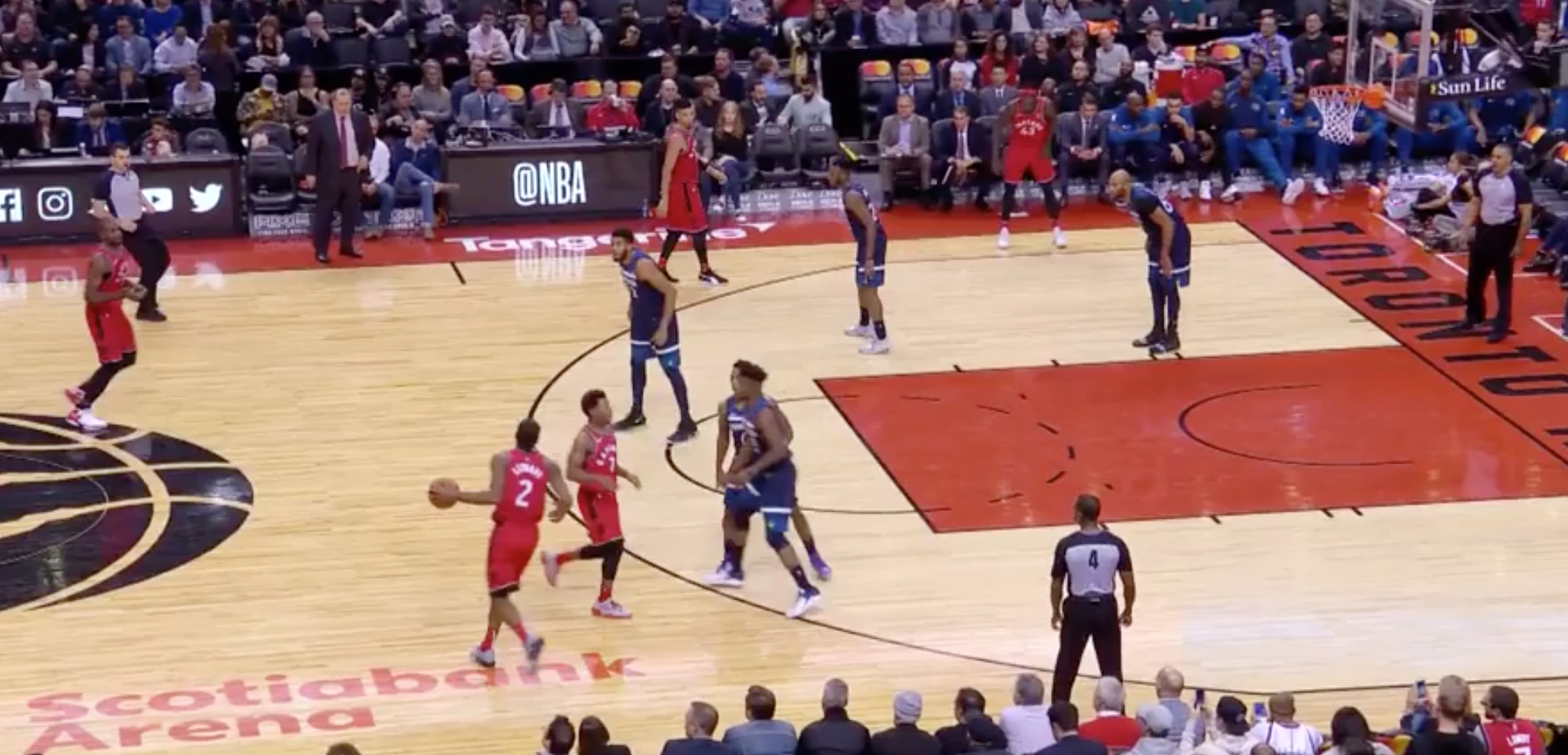
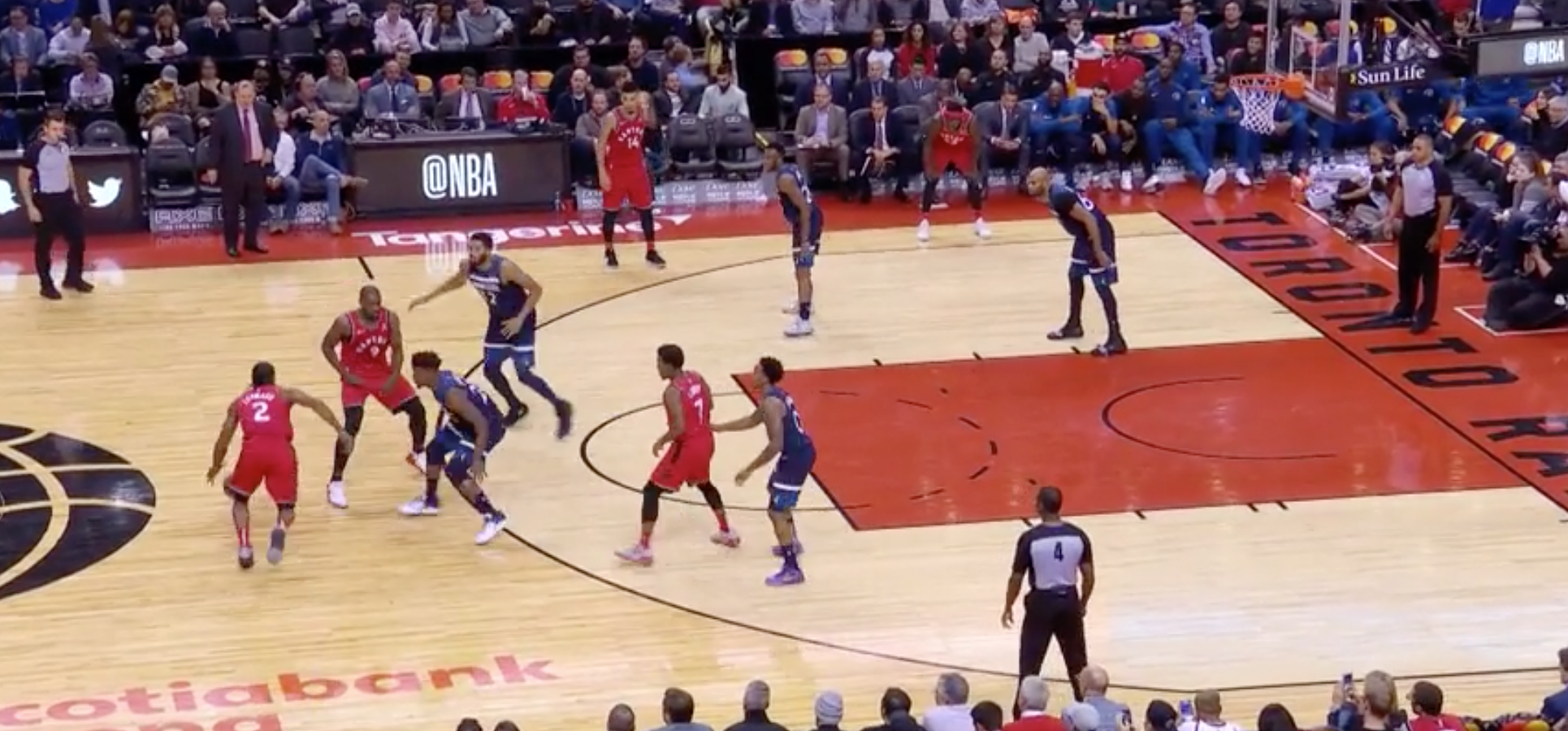
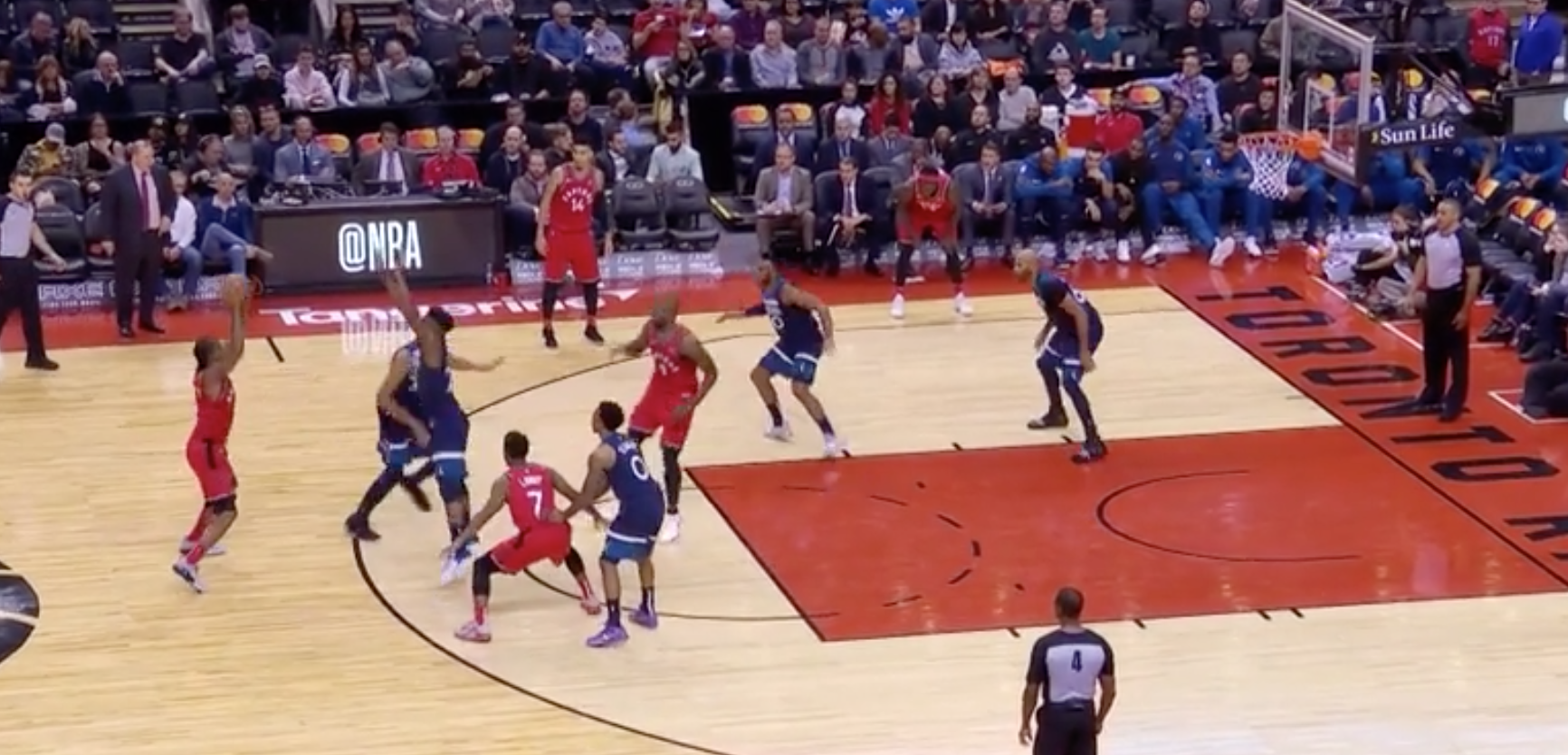
Whether rolling to the basket, popping out for a jumper near the high post, or simply staying put and fooling defenders as they attempt to guess where Ibaka will go after the pick is set, he’s been especially effective as an on-ball screener.
Ibaka has also proven to be more active in transition — under Nurse the Raptors are making a point of creating buckets off of turnovers — and he’s found success filling the lane on fastbreaks, whereas he seemed to often leak out to the perimeter in those situations last season.
Taking it to the rim
You don’t have to watch more than a handful of possessions to see that Ibaka is playing with more aggression on the offensive end. As opposed to waiting for defenders to sag off of him in order to hit open shots, he’s making a point of doing what he can to get to the rim.
Now, instead of relying on his ability to stretch the floor, Ibaka is using that skill set to take advantage of defenders who don’t want to leave him alone beyond the arc (despite his three-point shooting being his only weak point this season, shooting just 20 per cent after flirting closer to 40 per cent the last two seasons).
It’s been a major point of emphasis from the Raptors’ coaching staff to their big man, and in practices they run Ibaka through drills in which he catches the ball at the three-point line and works on blowing by his defender to either pull up in the paint, find open teammates or use the middle of the court as a runway to take off toward the rim.
That work has been paying off, and this dunk during Sunday’s win is a sequence Ibaka has practiced plenty this season before putting it to work in real game action:
Serge Ibaka has 20 points and counting in the first quarter pic.twitter.com/gW1QLnwTql
— Sportsnet (@Sportsnet) November 5, 2018
The Lowry Effect
Ibaka is earning the early praise for the turnaround in his productivity, but it’s important to also acknowledge the role Kyle Lowry has played in putting his teammates in positions to score.
“Kyle is making the game so easy for me and JV,” Ibaka told Sportsnet’s Eric Smith following Sunday’s win in Los Angeles, a game in which Lowry registered 15 assists, extending his league-leading total to 116 so far this season — a stunning 31 more than any other player in the NBA. Lowry had nine assists in the first quarter alone, with Ibaka the recipient of five of those.
The point guard and centre are clearly on the same frequency this season; 3.4 of Lowry’s 11.6 assists per game come courtesy of an Ibaka basket — by far the highest mark of any Raptor and double the next-highest teammates.
Also not to be overshadowed amid Ibaka’s successful start is the play of Valanciunas, too. He may have come off the bench for most games and is playing a career-low 18 minutes per game, but he’s making the most of his playing time, scoring 14 points per game. If the centres do their job in Nurse’s system, simplifying their approach and looking for opportunities at the hoop, they’ll succeed.
What’s most remarkable about Ibaka’s hot start is how dramatically he’s shifted perceptions through his early season performance. Following an up-and-down campaign in 2017-18, Ibaka was practically left for dead by Raptors fans at the close of the 2017 playoffs. After posting 23 points, 12 rebounds, and two blocks in Toronto’s first post-season game, he proceeded to disappear down the stretch, averaging just seven points and five boards while shooting 36 per cent. As his athleticism waned, it looked like his best years were far behind him and that a stiff decline was imminent, if we weren’t already seeing it before our eyes.
Throughout the off-season there were (fair) questions about where he fit in Nurse’s rotation, whether he’d be relegated to the bench, or would have a consistent role at all. Nurse obviously saw things differently, and has been able to maximize Ibaka’s abilities, a fundamental trait of a good coach. And credit to Ibaka for buying what the rookie coach has been selling and showing a willingness to evolve.
After all, it’s hard to argue with the results.
[relatedlinks]