After posting one of the most dominant regular season campaigns in league history, the Golden State Warriors finished the job by bringing the Bay Area its first NBA championship in 40 years.
And in doing so, they taught Cleveland, LeBron James, and the rest of the NBA exactly what it takes to win it all in today’s NBA.
While the Warriors are a wholly unique team led by a one-of-a-kind player and boast the subsequent personnel able to employ their free-flowing, pass-heavy offense in a way that most teams can’t, there are still lessons the 2014-15 champs can impart on the 29 other franchises looking to hoist the Larry O’Brien trophy in the near future.
Character matters:
Andre Igoudala may be one of the more improbable Finals MVP’s we’ll see—he didn’t start a single game this season and hadn’t scored more than 25 points, his total in the title-clinching game, since November 2013— but his ascension from enticing prospect, to All-Star talent, to NBA champion shouldn’t be too surprising given the work he’s put in.
Two years ago at the NBA Summer League, just days removed from being acquired by Golden State from the Denver Nuggets, I caught up with Igoudala after a Warriors game he had attended. A voracious reader, we started talking about what he was reading these days. That’s when he pulled a book out his backpack and told me he was ‘studying, taking notes’. The book was Phil Jackson’s Eleven Rings.
The notion that he’d win a title any time soon then seemed, to be honest, way far-fetched. The Warriors at the time were still an exciting but flawed team who’s burgeoning star couldn’t stay on the floor due to repeated ankle injuries. Igoudala would certainly help, but Golden State was presumably a few years from being a true contender. Still, watching Igoudala rise to the moment it was hard not to remember the guy spending parts of his Vegas experiences with his nose in the pages of a coaches memoir. Sacrifice, a sense of the moment, an understanding of team and how to fit within that concept. Igoudala, evidently, learned well and was able to put it into practice.
Winning teams actively pursue players like Igoudala—guys who have the intelligence and mental strength to match their physical gifts. Those who understand, or are willing to learn, exactly what it takes to win. They’re fewer and further between than you’d think.
Drafting matters, too:
Steph Curry at No. 7 in 2009. Klay Thompson at No.11 in 2011. Harrison Barnes, Festus Ezili, and Draymond Green at Nos. 7, 30, and 35, respectively, in 2012.
This was once a franchise with a piss poor draft record (lottery picks in the early-mid 2000s include: Anthony Randolph, Patrick O’Bryant, Ike Diogu, Mickael Pietrus, Andris Biedrins), but the 2014-15 Warriors showed what a difference good drafting can make in helping to build internally. And they also proved that you don’t need to win the lottery every year to do so.
The big man has died a slow, agonizing death:
Andrew Bogut is a very solid NBA player who was rendered essentially useless by the time the Finals wrapped up, as the Warriors smartly leaned more and more on their effective brand of small ball and forced the Cavs to do the same.
While you’d think there would always be a role for brooding seven-footers that protect the rim on one end and attack it on another, these Finals only highlighted (cemented?) a greater trend that’s been going on in the NBA for years, as more and more teams will look to find a Draymond Green or Tristan Thompson-type player who is comfortable guarding out to the perimeter but also has the size and strength to bang down low. “Versatility” is and will continue to be the most coveted skill for new age big men.
It’s one of the reasons the upcoming NBA Draft is so interesting, with two bigs—one traditional (Jahlil Okafor) and one who fits the new-age mould (Karl Towns)—atop most boards. How much longer will GMs still value the Okafor type before passing on them in favour of centres and forwards who can stretch the floor and play multiple positions? It came up on the Free Association podcast (Sportsnet’s weekly NBA show) this week, but if a player like Jonas Valanciunas was in this draft how far would he fall?
Tim Duncan aside, when was the last time a traditional big man has been the focal point of a championship team?
At the end of the day, small ball won Golden State the title. Yes, they had the perfect mix of complimentary talent to pull it off, but in the coming months and years look to see plenty of teams prove exactly why the NBA is a copycat league.
Can’t do it alone:
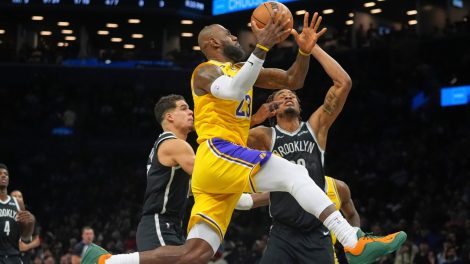
This may be painfully obvious, but after watching LeBron James push himself to the brink of exhaustion (or past it) game after game while posting unfathomable numbers along the way only to fall way short, needless to say one player alone can’t win a title.
While those around him stepped up early in the Finals (and throughout the playoffs), it was frankly hard to watch just how little help the King was getting during Game 6, particularly on offense. Tristan Thompson looked like he was up to the task in the first half, posting 11 points, but only managed four second-half points. J.R. Smith starting knocking down three pointers only when the game was more or less out of reach late in the fourth, while James Jones, Iman Shumpert, and Matthew Dellavedova combined for just 14 points in more than 84 minutes of action.
Those around Golden State’s MVP, Steph Curry, meanwhile came through in droves with five players scoring in double figures, including Shaun Livingston and Festus Ezeli (and, amazingly, none of them Klay Thompson).
“Strength in Numbers”:
That was the Warriors rallying cry all season, and in the Finals we obviously saw depth play a major role when it came to the fatigue factor. As head coach David Blatt kept the Cavaliers rotation to essentially seven player for the duration of the Finals, his counterpart, Steve Kerr, used ten players who saw meaningful minutes in this series. As a result, as each game wound down, the Cavs were tired and beaten down, running on empty while their counterparts were able to bring in relatively fresh legs to keep pushing the tempo and compound Cleveland’s problem.
But just as importantly, that depth provides insurance in case of a cold spell or injury. Sure, no backup point guard will be able to replicate what, say, Kyrie Irving, brings to the table. But the drop-off in talent between him and his replacement all-but killed the Cavs chances in this series the moment Irving left the court (sorry, Matthew Dellevadova, it was fun for a couple of days there, wasn’t it?).
As leagues continue to chase the dollar and seasons subsequently become longer and longer, the heavy toll it puts on players bodies isn’t getting any lighter. This season saw major players on contending teams like Irving, Love, John Wall, Mike Conley, Al Horford, Derrick Rose, Kevin Durant, Russell Westbrook and others miss considerable time to injury, forcing their respective teams take a desperate look down the bench to find a replacement.
Of course, the Warriors benefited by having an entirely healthy roster during the Finals, and had they lost, say, Klay Thompson, they would have obviously been worse off for it. Yet with players like Igoudala, Leandro Barbosa, and Shaun Livingston at their disposal, the Dubs could have conceivably weathered the storm in a way Cleveland clearly couldn’t.
LeBron said it best after Game 6: “We ran out of talent.” That was never a problem for Golden State.