"It’s about time."
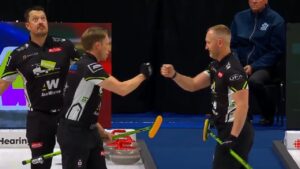
That’s what Brad Jacobs said after defeating Switzerland’s Team Yannick Schwaller 4-3 to win the HearingLife National in Sydney, N.S.
He meant it in multiple ways.
First for himself. Sunday's win was the first time since the 2019-2020 season, when he played with Marc Kennedy, his third now, and his two cousins E.J. and Ryan Harnden that Jacobs won a Slam title.
Second for his team, because finally — after forming this team of Kennedy, second Brett Gallant and lead Ben Hebert before the 2024-25 season, which already won the Olympic Gold Medal and the Brier together — they can now say they’ve won a Grand Slam trophy as a unit.
“I’m so proud of the guys for the way that they played all week,” Jacobs said in his post-game interview with the GSOC broadcast. “Just staying tough and sticking with it. Feels so great, and I can't wait to celebrate.”
The first Slam win as a team is always special, but for the Alberta-based squad, this one might mean more thanks to how they earned it.
During their quarterfinal match against USA’s Team Danny Casper, they were down 5-2 with two ends remaining. It looked like they would be going home early. But that’s when they were handed a lifeline.
Casper collapsed and gave up steals in three straight ends to hand Jacobs the win. So, the skipper knew they couldn’t waste the opportunity.
“When the curling gods give you a really good break like they did in the quarterfinal we had this week, you got to take advantage of it,” Jacobs said.
It was the type of final you’d expect between two titans of the men’s game.
A great battle where neither team would give an inch.
“I expected exactly what we saw out there in that game. You know, just two teams out there battling it out, making virtually everything,” Jacobs said.
He wasn’t wrong. As a rink, the Canadians made 89 per cent of their shots and had an edge of plus-15. The Swiss men made 81 per cent of their shots and had an edge score of plus-7. The edge score means what the field would’ve shot on average with the same shot mix each Jacobs and Schwaller’s teams faced during the final.
In the first end, Jacobs made a nice board-weight hit-and-roll with this last, leaving Benoit Schwarz-van Berkel, the fourth stone thrower, with a difficult double takeout to score two if made right.
Schwaller just missed the line call on the shot, and it barely overcurled, leading to a steal of one for Jacobs to start.
That set the tone for the next six ends — it was either a blank or a single point for either team to result in them being tied 3-3 after seven.
However, it was a mistake by Schwarz-van Berkel in the seventh with his last stone that gave Jacobs the hammer coming home. The Swiss team wanted to give up a steal of one to trail 4-2 and keep the hammer, but since Schwarz-van Berkel was drawing against four, he didn’t want to be light.
He outdrew all the Jacobs’ counting stones to actually take one.
This gave the Canadian team an opportunity to play a clean eighth end where Jacobs had an open hit for the win.
Kennedy makes history
Apart from this first Slam title for the reigning Olympic champions meaning more because of the comeback in the quarterfinals, this win will go down in the history books for Kennedy.
With the victory, he tied his old teammate Kevin Martin for the most Slam titles on the men’s side with 18.
“Yeah, it feels amazing. It’s been a long time to get this one,” Kennedy said post-game in an interview with the GSOC broadcast.
“Just means I’ve been around a really long time and I’ve been lucky enough to have some pretty incredible teammates including Kevin Martin. So, very fortunate to have a long career and yeah, excited to get my 18th Slam. This was a tough one.”
After the last quadrennial finished, most of the chatter about retirement with Jacobs’ team was on Kennedy’s front. It made sense since they'd just won the Olympics, where he turned 44 years old right before the event started.
Back for at least one more season, though, Kennedy looks as good as ever and was a major factor in why Jacobs won on Sunday.
He outperformed Schwaller at third stones, and even though nobody could generate more than a single point in an end, Jacobs had slightly easier shots as a result.
Scary times with the clock
For a hot minute it looked like the clock was going to be an issue for the Alberta rink.
They had 3:07 with 11 rocks left to play in the game. Then 2:04 with nine rocks left, and 1:35 left to play the final end.
Of course, they'd done this plenty of times. Experience that no doubt helped with the foresight to save both timeouts. They got through the first five rocks of the eighth end wicked quickly as well, so they didn’t have to use either timeout until Jacobs’ final two shots in the eighth.
So, even though there were only 30 seconds left on the clock as Jacobs went to throw his final stone, they called a timeout to give him — essentially — two minutes. This let him go through a full routine in the hack without being rushed to make the game-winning hit.
The next stop on the Slam tour is the GSOC Open, happening Dec. 1-6 in Thunder Bay, Ont.


 1:49
 0:57
 1:04