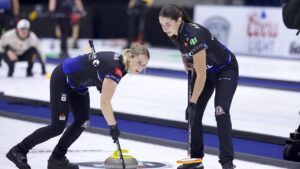
It’s been a fabulous seven days for Sweden’s Team Isabella Wrana.
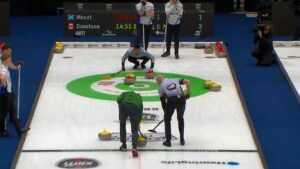
After winning the European Curling Championships in Ostrava, Czechia last weekend, the Swedes double-dipped with a P&H Masters title by defeating Japan’s Team Miku Nihira 11-2 on Sunday in Medicine Hat, Alta.
It’s the second Grand Slam of Curling title for skip Wrana, third Almida de Val and lead Maria Larsson – their first came at the Players’ Championship in 2023 – while it’s the first Slam title for second Moa Dryburgh, who joined the team full time this season.
“It feels amazing, just doing this together as a team and the girls played so, so well this whole week, so it made my job very easy,” Wrana said in her post-game interview with the GSOC broadcast.
Well, that’s half of the story. Yes, Wrana’s team played great, but Nihira's mistakes loomed large.
In the first end the Japanese skip was slightly heavy on the freeze attempt with her last stone, rolling off Wrana’s rock and leaving the Swedish skip a shot for three, which she made.
When Wrana had the hammer again in the third end, it looked like Nihira would at least get a force out of the Swedes, if not a steal. But Nihira was slightly off again with both of her stones, leading to another three to blow the game wide open for Wrana.
The Japanese team, which became just the third in their country’s history to reach a women’s GSOC final, grabbed a single in the fifth end before having another disastrous end in the sixth that led to Wrana having an open draw to score four. That was enough for Nihira to shake in defeat.
It wasn’t like Nihira’s team was that far off, they just struggled on one shot the whole game.
Every time a player on the team would attempt a come-around draw, they would just barely touch the stone they were trying to wrap around, spilling into the open. Maybe against another team on the women’s tour, it would’ve been OK, But that doesn't work when playing against Wrana, arguably one of the best hitting teams.
Japanese team might have run out of gas
Maybe part of the reason Nihira’s squad struggled so much during the final had to do with the amount they played the day before
On Saturday they had to play at 8 a.m. local time against Canada’s Taylor Reese-Hansen in the tiebreaker to even reach the quarterfinals, where they played No. 1 seed Eun-ji Gim of South Korea at 3 p.m. before facing Canada’s Selena Sturmay in the semifinals at 7 p.m.
Although they got to rest until their final started at 3 p.m. on Sunday, that’s still a long day of curling for anyone, which could have led to the inconsistency on the ice against Wrana.
Per the GSOC broadcast, the last time a team won a Grand Slam of Curling event after needing to go through the tiebreaker was Canada’s Team Kerri Einarson at the Champions Cup in 2022.
At the same time, though, the Swedish women did hop on a plane right after winning the European Championships to fly halfway across the world and had no time to adjust their body clocks throughout the week.
Rookie second shines for Team Wrana
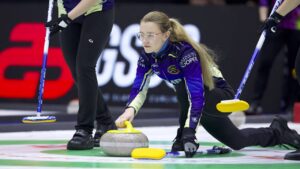
In Dryburgh’s second Grand Slam event, she proved to be a massive reason why Wrana kept finding success against Nihira.
The rookie made 92 per cent of her shots overall, but 100 per cent of her hits – the most important attribute a second can have. It wasn’t like the shots she was being asked to play were easy, either. Dryburgh had a plus-14 edge rating, meaning with the same shots, the rest of the GSOC field on average would’ve shot 78 per cent.
With her connecting on all of her hits, it allowed de Val and Wrana to have easier shots to apply more pressure on Nihira.
“She brings a lot of youth of course to the team,” Wrana said. “She’s also a great sweeper, great thrower and always positive, and she likes to win.”
The next stop on the Slam tour is the GSOC National, Nov. 17-22 in Sydney, N.S.

 0:47
 0:44