
Golf has been looking for its next Tiger Woods since he tore up his knee, knocked over a fire hydrant and shredded his life, career and reputation nearly a decade ago.
For any number of reasons it feels safe to say Jordan Spieth won’t be another Tiger, who won 14 majors in 11 years and was so good for so long he seemed like a robot, until he unraveled in the most human of ways.
Spieth?
He’s no robot. He’s the guy who gets halfway to the airport and has to turn around because he forgot his passport.
Woods will join Jack Nicklaus on golf’s Mount Rushmore. Spieth seems more likely to have a rollercoaster named after him.
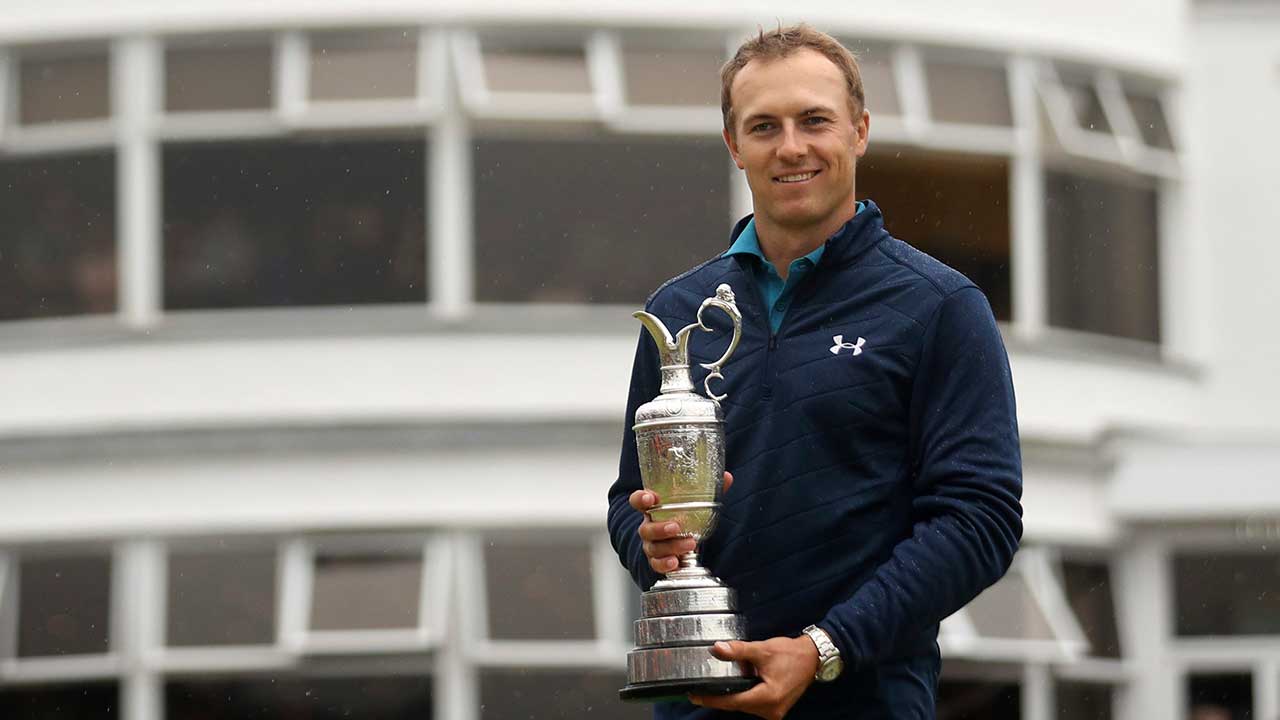
As a result Spieth is on track to become something Tiger never managed – the kid from Texas is showing signs of becoming the people’s champ. His game – brilliant as it has been through three seasons at or near the top of the World Golf Rankings – is just inconsistent enough to introduce an element of doubt even when he’s leading a major championship wire-to-wire as he did in winning the 146th British Open at Royal Birkdale on Sunday.
And not just among those watching. The man himself is as uncertain at times as everyone else.
Starting with a three-shot lead Spieth bogied three of the first four holes. He had dropped into a tie with playing partner Matt Kuchar by the turn.
And then things got bad.
His tee shot on the 13th went off the moon, the kind of shot the worst hacker hits on his worst day, just farther.
But Spieth at least has experience having hit his tee shots to strange places – he hit just 30 per cent of his fairways on Sunday. He had the presence of mind to find out if the driving range was out of bounds or not. Learning it wasn’t, he took a penalty shot for declaring his ball unplayable, then found relief on the range and relief again from the equipment trailers there. He then managed to figure out a yardage from the practice tee to the green, hit a three-wood short of the green and eventually made a bogey putt after staring at double or worse.
"Honestly, if I was a very straight driver of the golf ball, I would have made a different score on that hole," Spieth told reporters of his clever use of the rulebook under duress. "And having been in unplayable situations before, I just asked the questions, is the driving range out of bounds? And I got the answer, no. And I thought, well, then, that’s a much better location for me to hit the next shot because I can get it much closer to the green and it saves me almost a full stroke from going back to the tee."
Even then he was in a less than ideal spot, trailing Kuchar by a shot with five holes to play and four-over for the day.
[relatedlinks]
And yes he was having his doubts about his ability to close. Spieth joined Nicklaus and surpassed Woods by becoming just the second golfer to win three different majors before turning 24 years old. But he still might be more widely known for how he lost the 2016 Masters: blowing a five-shot lead on the back nine, and taking a quadruple seven on the par-three 12th, hitting one shot so fat the divot went farther than his ball. It was a muff job that will live on in major championship lore and instantly made Spieth one of the guys.
He’s won tournaments since, but not a major. And now it looked like he was letting another one slip away.
"I knew that another major would be the one thing that would, I think, just completely, [put me] over the hill, you know? [Prove] I’m capable of closing these majors out," Spieth said. "Because you just — I didn’t really do much wrong [at the Masters] just hit a couple of bad swings. And all of a sudden it was, in my own head. ‘How could I not close out a five-stroke lead with nine to play?’
"And today could have been [again]… you just don’t know really what your mind is going to do to you sometimes. You can control it to an extent but certain situations are going to bring more tension and you have to kind of channel that the right way, play the right shots. And that was a difficult thing to do today because it was just so up and down… Today took as much out of me as any day that I’ve ever played golf."
But it’s the cracks in his game and his psyche – and the way he manages to plaster over them in the nick of time – that promise to make his legend one that that anyone who has coughed up a hairball among friends over a five-dollar putt can relate.
By that standard his turnaround after walking off the green with his round-saving bogey on 13 will forever stand alongside his screw up at Augusta – the same guy who gave away the Masters blitzed the British Open.
Back from the brink, Spieth went birdie, eagle, birdie, birdie – a run of five-under par through four holes seemingly from nowhere — to secure the Claret Jug.
Kuchar, seeking his first major at age 39 after a long and distinguished career on Tour, played the same four holes in two-under-par and lost the lead, his closing 69 good enough only for second place.
"It’s crushing. It hurts," Kuchar said. "And it’s an excitement and a thrill to have played well, put up a battle, put up a fight.
"I can only control what I do, how I play. Jordan is a great champion and certainly played that way in the finishing stretch today. It was impressive stuff when a guy does something like that. All you can really do is sit back, tip your cap and say, ‘well done.’ And it was certainly a show that he put on."
It was, both for how close Spieth came to frittering away his good fortune, and the breathtaking way he kept it all together.
All those watching can relate to at least the first part of that scenario, if not the latter. It makes Spieth, who will have a chance to become the youngest golfer in history to win the career Grand Slam next month at the PGA Championship, the emerging legend who plays a game with which most golfers are at least passingly familiar.