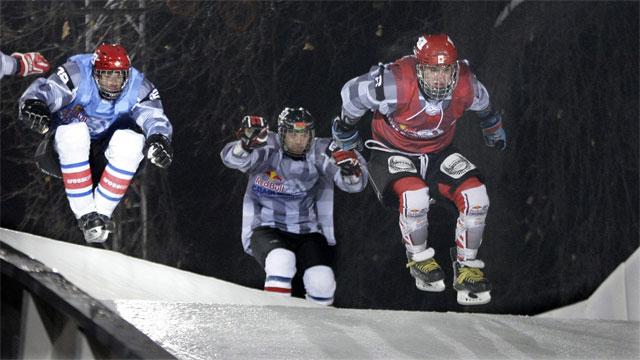

“This isn’t for beer-league players to come out and mess around. It’s a very dangerous sport. You have to take it seriously,” says Scott Croxall, the world’s third-fastest ice cross downhill racer.
Croxall is, of course, telling this to a beer leaguer who came to mess around, a beer leaguer who fears clipping his fingernails too short and hasn’t taken much of anything seriously since he realized the NHL’s idea of labour negotiations was a joke.
Oh for three.
“You definitely have to be a strong hockey player. I’d say anyone from junior to semi-pro guys should be trying out,” Croxall continues. “If you’re serious about it and train enough, anybody can do it, but it’s hard.”
Damn right, it’s hard. And we’re not even skating downhill.
Given a few practice trials on Toronto’s Red Bull Crashed Ice qualifying course — a series of belly slides under low-bars, hurdles over pyramids and pivots around pylons, all at top speed if you want to make the cut-against Croxall — Johnny Beer League’s best time is still 10 seconds off the 23-second pace needed to navigate the obstacles and qualify for the series, which kicks off its five-stop 2013 tour this weekend in Niagara Falls, Ont.
Catch the Red Bull Crashed Ice Niagara Falls finals live on Sportsnet Saturday night at 8:30 p.m. ET/5:30 p.m. PT.
Qualification for the increasing popular ice cross downhill is open to all but humbling for most.
The fastest Canadian qualifier for Niagara Falls was London, Ont.’s J.P. Stollar, who completed the Toronto course in a speedy 22.08 seconds. The slowest to make it finished in 29.34 seconds; her name is Lauren MacLean and she’s from Charlottetown, P.E.I.
The world’s top 64 seeded athletes, 15 of whom are Canadian, automatically qualify. Croxall is one of them.
Visually, the sport of ice cross downhill bears a resemblance to ski cross or snowboard cross, with its sloping curves, steep drops and the premium it places on speed and positioning. Not to mention the fact these ordeals must be held outdoors in cold temperatures, its spectators bundling up (perhaps avec flask) for warmth along the length of the course.
But its best athletes come almost exclusively from a hockey background.
“Definitely,” Croxall responds when asked if he wished to be competing with a stick in his hands instead. “The top guys on tour all played semi-pro hockey pretty much. Obviously everybody dreams about being in the NHL, but it doesn’t happen. This is the next best thing for us.”
So it’s fitting that Toronto’s qualifiers take place at the MasterCard Centre, a four-rink training facility booking ice time without its wealthiest tenant. (Locked out, the Leafs aren’t practising here right now.) Like the Centre itself, Red Bull’s skaters operate one step below the big show.
Mississauga, Ont.’s Croxall is quite literally following in the skate-steps of older brother Kyle, the 24-year-old reigning champion of Crashed Ice. The brothers grew up on hockey; it’s their favourite sport, easy. On the Crashed Ice website, Kyle lists his sporting idol as Wendel Clark; Scott’s is Wayne Gretzky. Browse their Twitter accounts, and you’ll spot interactions with NHLers and those who cover the game.
Scott, who will celebrate his 22nd birthday just days after the Niagara event, played forward for the Junior A Mississauga Chargers in 2010-11, registering five points in 11 games. But when he realized that he wasn’t Entry Draft-bound, he mimicked his brother’s strides. (Kyle, too, played with the Chargers, in 2008-09; he’s now a firefighter.) “My brother was into (ice cross) before me, so as soon as I turned 18 (Red Bull’s minimum age) the following year, I joined, qualified here in Toronto, and I’ve been in it ever since,” Scott explains. “I wouldn’t be doing it if I didn’t get that rush. There’s no other feeling like it. No one else has been able to skate downhill on ice before until now.”
Today, for the Croxall brothers, hockey serves as a means to an end. It’s their primary means of getting in shape for Crashed Ice, supplemented by strength training in the gym.
Scott Croxall says he trains for the season’s downhill circuit five or six days a week, mostly logging ice time due the premium the sport places on being stable on your blades. Like a hockey career, a pro or semipro ice cross racer would be content to have a career that lasts a decade.
Despite suffering a few minor injuries, Croxall strives to succeed not only for his bank account’s sake — the top eight racers at each stop cash a cheque, and a bonus is paid to those who amount the most overall standings points — but because for guys like him, young men whose unyielding passion for aggressive competition on ice, lining up at Crashed Ice’s starting gate is the closest thrill-wise he’ll to lining up at the face-off circle.
“There is money involved, but it’s more for…” Croxall stops, digging for the right words. “We’re on TV. This is basically our show. This is our NHL. We never made it, so we’re just trying to be the best at it.”
brightcove.createExperiences();