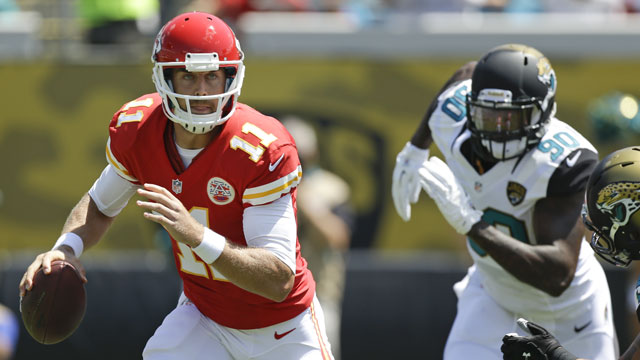

Add a decent quarterback and a competent coach to six Pro Bowlers and a 2-14 record, and what do you get? Alex Smith and the Chiefs are set to challenge for a playoff spot.
Dustin Colquitt jogs onto the field, his team down 35 with two minutes left in the fourth. It’s a cold late-December night in Denver and the Chiefs’ Pro Bowl punter bounces up and down and into the occasional balletic hamstring stretch to stay warm and limber. Both lines settle in front of him and there’s the familiar charged stillness as he waits for the ball. The snap is true. Colquitt catches it, takes two steps and left-foots it toward the clouds above Mile High.
The ball hangs in the air—long enough for any Chiefs fans left watching at home to drop their heads into a sad, slow shake, returning their eyes to the screen just in time to see Denver return man Jim Leonhard backpedal and fair-catch it at his own 13. As Denver kneels out the clock, those same fans have time to wonder why they’re still watching the last two minutes of a 38-3 week 17 pasting that adds an exclamation point to a league- and franchise-worst 2-14 record; why they didn’t reach for the remote when Peyton Manning handed the keys to Brock Osweiler at the beginning of the fourth. Why they ever even bothered cheering for a team that didn’t hold its first lead of the season until the first quarter of a week 10 loss to the Steelers.
In short, 2012 was a rough year to be a Chiefs fan—and an even rougher year to be a Chief. It’s probably unsurprising, then, that the popular narratives coming out of Kansas City in the lead-up to the season are heavy on turnarounds and redemption. What is surprising is just how rosy the storylines have been. Fired after leading the Eagles to a 4-12 record last season, Andy Reid has returned to his coaching roots in K.C. with an enthusiastic hands-on approach that has him dropping into a crouch to teach technique to the O-line whenever the mood strikes him. Felled by a concussion before losing his starting spot and getting shunted out of San Francisco, Alex Smith is nevertheless “the best [quarterback] in the league,” in the words of new offensive coordinator Doug Pederson. The air is so thick with optimism, it seems that just donning a Chiefs uniform will imbue Smith with the ability to throw downfield—just wait for the regular season to start, says star receiver Dwayne Bowe, “that’s when you’ll see Bombs Over Baghdad.”
Smith is not going to emerge from the Chiefs’ huddle reborn as a 60-yards-off-his-back-foot gunslinger. But just because the hype machine in Missouri has gotten a bit overzealous doesn’t mean the promise of a massive turnaround under Reid and new GM John Dorsey is unrealistic. The challenge is to push aside the narrative-driven optimism for a better look at how the Chiefs have clawed back to on-field relevance. Because, fuzzy football stories aside, in a division that falls off a cliff after Denver and a conference with serious room for upward mobility, this team is relevant. For all their collective failings last season, K.C. still sent six players to the Pro Bowl. They’ve added to that talent base on both sides of the ball this off-season, and the new coaching staff is set to make better use of what’s already there.
Smith is the biggest reason for hope. Even if you want to credit the tight coaching of Jim Harbaugh and Greg Roman for his spectacular numbers over his final two seasons in San Francisco, Smith is still a massive upgrade from the Matt Cassel–Brady Quinn duo that helmed the K.C. offence last season. Cassel was so bad that when he was concussed by a hit from the Ravens’ Haloti Ngata in week five, fans at Arrowhead cheered. Quinn may have been even worse. Combined, the pair threw just eight touchdowns last season, the fewest in the NFL. They notched the league’s second-lowest team QB rating and finished 30th in yards per attempt and 27th in completion percentage. Heady stuff.
Smith looked excellent in his first pre-season game and his allergy to turnovers (he threw just 10 picks in 25 starts the past two seasons) will be a godsend for a Chiefs team that tied for the worst turnover differential in football last season—a minus-24, largely the result of poor fumble-recovery luck and Cassel and Quinn’s league-leading interception percentage. The receiving corps he’ll work with is nothing to write home about, but Bowe is a former Pro Bowler with good size who’ll demand the occasional double-team. Reports from camp have free-agent acquisition Donnie Avery as the opening day front-runner for the No. 2 job. Avery drops a lot of balls and is most effective as a situational deep threat. Slotting him in the two spot could be particularly disastrous if it’s a sign of the coaching staff’s intention to push Smith into more challenging reads downfield.
Pro Bowl running back Jamaal Charles missed most of 2011 after tearing his ACL but returned to average an impressive 5.3 yards per carry last season, third among running backs. A mild foot strain saw him sit out a portion of the pre-season, but not having to spend his off-season rehabbing from major knee surgery is a definite plus. Reid has traditionally run a pass-heavy offence and that’s unlikely to change even though Charles is hands-down the Chiefs’ best offensive player. The K.C. attack will still be built around getting the ball in Charles’s hands, but more and more those touches will come on quick slants and screens—part of a flurry of short passes that will play into Smith’s skill set and the Chiefs’ depth at tight end.
Anchored by Pro Bowl linebackers Derrick Johnson and Tamba Hali, the Chiefs’ defence was much better last season than its numbers indicated. Ineffective coaching, a shaky secondary and an offence incapable of pulling its own weight combined to produce an overburdened unit prone to giving up big plays. The Chiefs are hoping that the off-season additions of cornerbacks Sean Smith and Dunta Robinson will shore up a secondary that retained some promising young talent in Brandon Flowers—a superstar-in-the-making coverage corner who’ll lock down one side of the field—and Pro Bowl safety Eric Berry. How well Smith and Robinson fit in K.C.’s system remains to be seen, but they can’t do much worse than last year’s back line, which gave up 36 passing plays of 25 yards or more.
The growth of 2012 first-rounder and athletic freak of nature Dontari Poe offers hope for the defensive line. Listed at six-foot-three and 346 lb., the 23-year-old reportedly gave up barbecue in the off-season and has dropped nearly 20 lb. Already strong as a run defender, he’s been described by the Kansas City Star as “near-unblockable” in training camp and that added ability to pressure opposing quarterbacks will be crucial for a pass rush that Pro Football Focus ranked 27th last season.
K.C.’s phoenix hasn’t risen quite yet, but this is clearly a talented team and, after an off-season full of smart front-office moves, there are persuasive reasons to think it will. A glance at the Chiefs schedule yields eight solidly winnable games (two apiece against Oakland and San Diego and one-offs against Jacksonville, Buffalo, Tennessee and Cleveland) as well as tilts against the NFC East (not exactly a powerhouse division) and the Colts, who are picked by most experts to regress this season. Take a quick swig of whatever they’ve been drinking in Missouri and it’s not inconceivable that Kansas City, 2-14 in 2012, could nab the AFC wild card. Then there’s the simplest argument for a bounce-back season: Starting from rock bottom, they can’t possibly be worse. Right?