ARLINGTON, TX. — The out-of-town scoreboard at Globe Life Field is difficult to miss: a tall, red column high above the batter’s eye in centre field cycles continuously through results and games in progress across MLB.
It was only Saturday’s second inning — not even 7:00pm local — when it displayed a seven-run Cleveland Guardians lead over the displaced Athletics, which, coupled with a Chicago White Sox victory earlier in the day, forced the Toronto Blue Jays to face an unfortunate proposition. Win to merely keep pace. Lose and fall even further behind.
Well, they lost, 6-2, falling three games back of the American League’s third wild card spot and three games under .500 for the first time since Sept. 1. And in the process, the limited scenarios that produce a Blue Jays post-season berth a week from now grew ever more improbable and far-fetched.
Yes, the math is getting awfully difficult. Sitting at 76-79 with seven games to play, the Blue Jays’ highest achievable win total is 83. Yet that’s only if they don’t lose again. Say they go 5-2. Then Toronto finishes with 81 wins, a total both Cleveland (80-75) and Chicago (79-76) are within striking distance of. The Blue Jays hold a tiebreaker over the Guardians; they don’t with the White Sox.
Technically speaking, the Blue Jays haven’t exhausted what slim margin for error remains in their season. But they’re uncomfortably close. They could be statistically eliminated as soon as Tuesday if they continue losing while Cleveland and Chicago carry on winning. And that’s to say nothing of the AL West teams, Texas (78-77) and Houston (77-78), which remain in the mix with more wins than Toronto has.
Going into consecutive bullpen days, a Max Scherzer outing, and a big ol’ question mark in Dylan Cease’s next turn on Wednesday — the Blue Jays are non-committal as to whether Cease makes that start after averaging the lowest fastball velocity of his career in a laborious Friday performance — things have looked better.
"We're still positive. Doesn't matter the result, we're still positive," said Blue Jays starter Jose Soriano, who was unluckily tagged for all six runs (five earned) his team allowed. "We're not going to win every game we play. The other team's trying to win, too. So, we try to control what we can control and play one game at a time.”
Days ago, most conceivable Blue Jays post-season paths likely included winning the four games Cease and Soriano started. Now, they’ve lost the first pair in resounding fashion. Of course, prevailing in a wild-card series certainly includes winning Cease and Soriano days. And if the Blue Jays can’t win them now, what makes you think they could win them then?
For his part, Soriano wasn’t Toronto’s primary issue Saturday, pitching efficiently over five innings before hitting rocky waters in the sixth. He threw an unusual number of curveballs — typically a secondary offering, it was Soriano’s most-thrown pitch on the night — using it early and late in counts against both sides of the platoon. That was a direct result of how Rangers hitters approached him, hunting the sinkers he’d been utilizing so effectively of late.
“I had good results throwing the curveball today,” Soriano said. “Sometimes the team you face is going to let you know what pitch you can use the most that day.”
The biggest adjustment Soriano’s made since joining the Blue Jays is vastly upping his sinker usage while deprioritizing his four-seam fastball, which hitters slugged .505 against through the end of July. It isn’t a coincidence that Soriano’s groundball rate has shot up in turn, sitting above 60 per cent through his first three September starts.
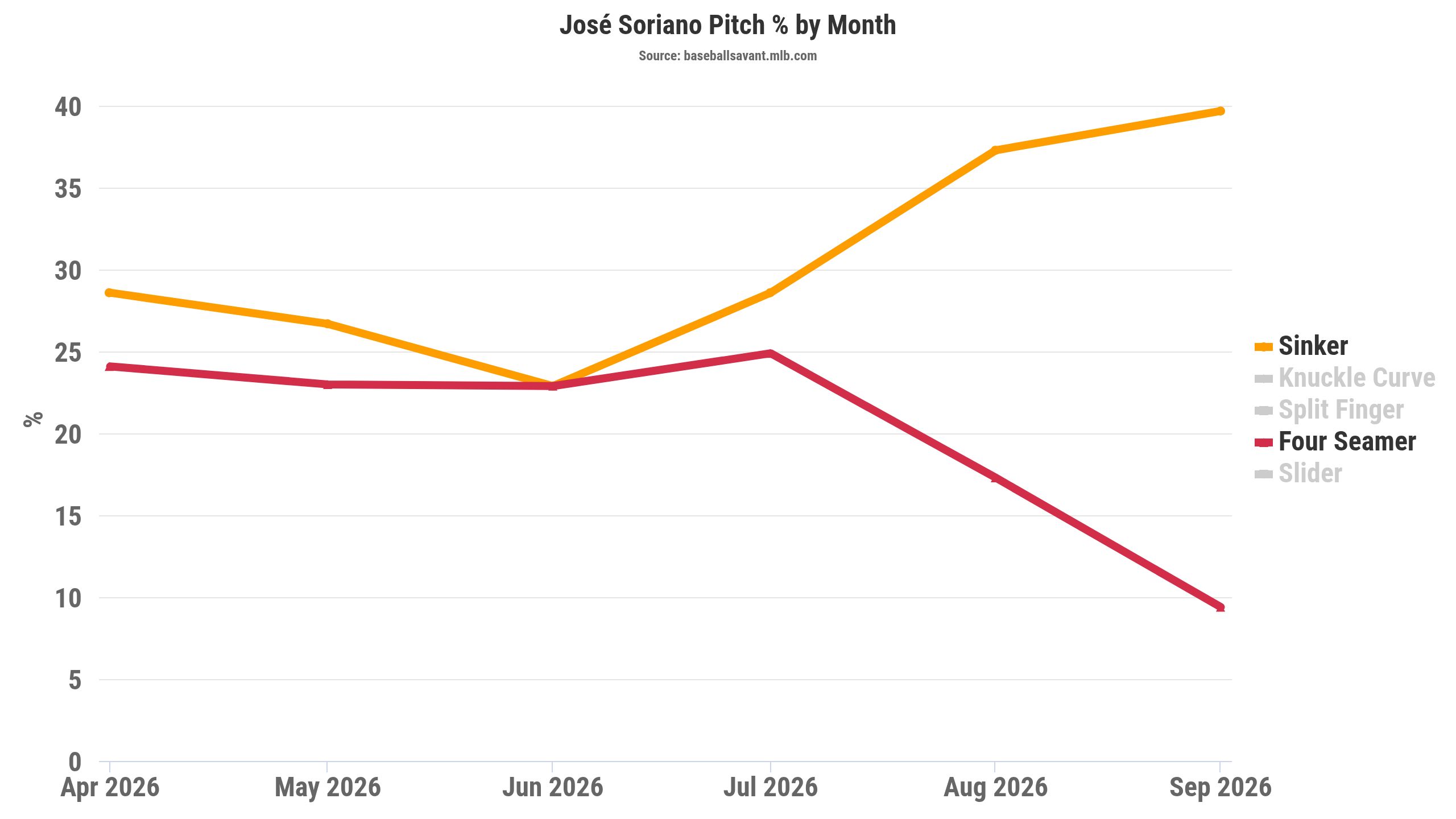
He’s traded in some strikeouts to do it, but Soriano’s found a way to get deeper into outings and give his team more innings. In June and July with the Angels, Soriano pitched into the seventh inning just once across 10 starts. Over his first eight outings with the Blue Jays, he’d already done it three times.
Yet, Soriano can pitch for days — it doesn’t matter if the Blue Jays can’t score. And MLB’s least productive offence (4.01 runs per game, dead last in the majors) has lived up to its billing so far in this series, scoring three times on 11 hits and three walks over 18 innings. Only two of those hits have gone for extra bases.
“I think you've got to slug a little bit more and force the issue a bit,” Schneider said. “If you're not doing that, you're trying to string together four or five hits in an inning. I think that's been the theme so far.”
As they have in 35 of 59 games since the all-star break, the Blue Jays coughed up an early lead as Josh Jung sat on a first-pitch Soriano sinker and shot it 356 feet over the right-field wall in the first. An inning later, the Rangers added a pair without getting the ball out of the infield thanks to a walk, hit batter, throwing error, and wild pitch sequence that — trust us — was as painful to watch as it was to read.
“It feels like the last couple games you're down early, and it makes it a little bit tougher to come back,” Schneider said. “You're looking for a big swing, a three-run homer or a base hit to score a couple to get back into it. I think falling behind early makes it a little bit tougher.”
The Blue Jays appeared to catch a break early when Rangers starter Cal Quantrill, who retired his first four hitters with a dozen pitches, left the game with one out in the second inning due to a lat issue he’s been managing since his last outing.
Quantrill’s been on a baffling run of strong results — he entered the night with six consecutive quality starts — that belie both the quantity and quality of contact he’s allowed, producing an ERA over a full run lower than both his xERA and FIP. But he put himself in the running for August’s pitcher of the month (1.45 ERA over six starts) by seldom walking anyone and off-balancing hitters with a six-pitch mix, which profiled as precisely the class of pitcher Toronto often struggles with.
So, all things considered, getting into the Rangers bullpen before the game was even 20 minutes old was a gift. But the Blue Jays had constructed the bottom half of their lineup for a right-handed starter and instead found themselves facing the left-handed Jordan Montgomery before most of their lefties even came to the plate.
That meant Nathan Lukes, Josh Smith, and Andres Gimenez all took their first plate appearances of the night with a platoon disadvantage. They all made outs. Then Brett Bateman, Toronto’s leadoff lefty, began the fourth inning with a soft groundout to second.
“You're trying to always beat the starter and then you try to pick out certain spots to where you don't want to get locked into something. But you want to save some moves for later in the game,” Schneider said. “But, at the same time, when you're behind in the game, it sometimes forces the issue a little bit earlier.
“You don't want to force things. You don't want to wait too long on some things. So, you're just looking at the leverage of the inning. But, yeah, it's always tough facing a guy you're not really prepared for.”
By the sixth, when Nathan Eovaldi took over from Montgomery, the Blue Jays remained hitless. Bateman and Alejandro Kirk finally broke the levee with a pair of hits in the inning to scratch across a run. But the Rangers immediately responded in the bottom half with two hits of their own, re-establishing their lead while chasing Soriano from his start.
Davis Schneider’s first-pitch homer in the seventh was a nice moment for him — his first in the majors since June 16 — that changed little other than a lone number on that tall, red scoreboard column high above the centre field batter’s eye. The one that was difficult for the Blue Jays to miss on Saturday for more reasons than one.