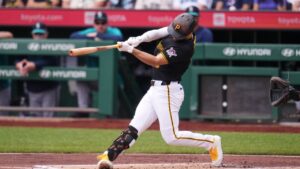
LAS VEGAS — As the Toronto Blue Jays seek to augment the offence that ranked last in MLB in runs scored, they’ve shown interest in Brandon Lowe, the left-handed hitting second baseman who hit 36 home runs for the Pittsburgh Pirates in 2026.
It’s an intriguing possibility, but it must be noted that free-agent talks were still in their initial stages as the baseball industry gathered at the Aria Hotel for the GM Meetings, which begin Tuesday. At this point, both sides have plenty of alternatives, so a little mutual interest opens up possibilities without any promises.
With back-to-back 30-homer seasons and improved defensive metrics up the middle, Lowe is considered one of the top free-agent hitters available, alongside Seiya Suzuki, Teruaki Sato, Randy Arozarena and Ryan Jeffers. Recognizing this, the Pirates made him a one-year, $23.15-million qualifying offer that he’s expected to decline in favour of a multi-year commitment.
Lowe's pull power has always stood out, with an average of 35 home runs per 162 games played at the MLB level. What's perhaps more surprising was how his work with the Pirates helped his defence, with his fielding run value jumping from fifth percentile in 2025 to 96th percentile in 2026. Between his bat and glove, Lowe generated a career-best 5.3 wins above replacement, according to Baseball-Reference.
To what degree that’s sustained over a multi-year deal remains to be seen but Lowe will at least start his next contract as a powerful up-the-middle player — something few top free agents can claim this year.
Altogether, it’s a possibility worth considering with the caveat that preliminary interest doesn’t necessarily mean talks will gain traction. Just as Lowe could sign with the Dodgers, Yankees or Pirates, the Blue Jays could turn their attention to Jazz Chisholm Jr. or Luis Arraez, whom they’ve pursued in the past and fits the high-contact profile they value.
For that matter, they could leave Ernie Clement at second base after he posted a .742 OPS in his first 106 games while earning an all-star selection before finishing with a .438 OPS over his final 52 games, when he was more beat-up physically than publicly known. Another possibility is trade deadline add Josh Smith getting reps at second base, with Clement playing regularly while moving around the diamond.
Alternatively, it’s entirely possible the Blue Jays focus more on an outfielder like Suzuki, or even a trade candidate.
Timing could change, but it’s a reasonable expectation that Lowe signs before Dec. 1, when MLB’s owners are poised to lock out players. That means there are likely three weeks to see if this early interest leads to something with real momentum.
Signing qualified free agents: As things stand, the current Collective Bargaining Agreement’s rules are expected to apply to this off-season’s business, which means teams that sign qualified free agents will still be subject to the loss of one or more draft picks.
As a club paying the Competitive Balance Tax, or CBT, the Blue Jays would forfeit their second- and fifth-highest picks while also sacrificing $1 million in international bonus room for signing a free agent who rejects a qualifying offer this winter.
Last year, they gave up two picks for the signing of Dylan Cease, their second-round selection and the compensatory choice they would have received for the departure of Bo Bichette. Their first-round pick was also pushed back 10 spots, from 29 to 39, because their 2025 payroll was more than $40 million above the CBT threshold of $241 million.
Unless the draft lottery moves the Blue Jays into the top six, their first-round pick in 2027, currently slated for No. 13, will be pushed back 10 spots because they again cleared the 2026 CBT line of $244 million by more than $40 million.
Signing-bonus sweeteners: With a lockout looming and the possibility of lost games — and therefore lost income for players — very real, an interesting tool teams can use to tempt free agents is structuring a significant portion of their 2027 earnings as a signing bonus rather than regular salary.
Unlike regular wages, signing bonuses must be paid in the event of a labour interruption, so clubs can essentially guarantee a player close to a full year of pay whether or not a full year is played.
Vladimir Guerrero Jr., for instance, built such protection into his $500-million contract two springs ago with 65 per cent of the total in signing bonuses, including $14 million of the $31 million he’s due next year.
Such flexibility alone won’t get deals done, but it could help break ties or push one team ahead of others at the finish line.
Rookie recognition: Blue Jays third baseman Kazuma Okamoto finished a distant seventh in a deep field for American League Rookie of the Year, with winner Kevin McGonigle of the Detroit Tigers a near-unanimous pick with 28 of the 30 first-place votes.
McGonigle also received two second-place votes, while runner-up Parker Messick of the Cleveland Guardians was the only other rookie named on all 30 ballots, getting two first-place votes.
Okamoto picked up one third-place vote, four fourth-place votes and six fifth-place votes after batting .232/.310/.452 with 33 home runs and 92 RBIs in 156 games.
Canadian outfielder Tristan Peters of the Chicago White Sox finished eighth with two third-place votes, a fourth-place vote and four fifth-place votes.