TORONTO — The first standing ovation came before first pitch as Max Scherzer took the field and Floor Seats by A$AP Ferg began to blare, the next bottom one when George Springer walked to the plate to the familiar Butterfly Effect by Travis Scott.
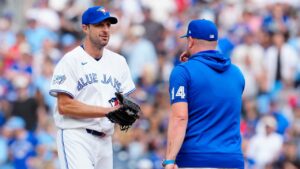
More followed after Springer doubled to open the third, was run for, and made the long walk back to the dugout as 42,131 at Rogers Centre feted him; when Scherzer told manager John Schneider with two outs in the seventh that he wasn’t coming out of the game, again when he came out for the eighth and finally when, at 114 pitches, he exited after a leadoff walk, walked off the mound, hugged his way through the dugout, with Springer at the end, and hopped into the stands to share the moment with his family.
They were beautiful goodbyes to one of the best pitchers ever, a true legend of the sport, and to a franchise icon who spent six transformative years with the Toronto Blue Jays after signing a then-club-record $150 million contract in January 2021. And in a 5-1, Game 162 victory over the Cincinnati Reds that was otherwise devoid of consequence, there was a goodbye to a disappointing, difficult and draining 2026 season for the defending American League champions, sending them into a winter in which the offence, first and foremost, must be repaired, with a lockout of players by owners looming when the sport’s CBA expires Dec. 1.
The only certainty, whenever the game’s next collective bargaining agreement is set, is that the Blue Jays will be different the next time they take the field, testing the legacy built once Springer signed and spurred along by Scherzer among so many others.
“My goal was to come here and to help win and to help any way that I possibly could help with culture, with friendship, whatever the case,” Springer said during an 11-minute chat with media before the game when he repeatedly fought back tears. “I'm very proud of what we've been able to accomplish as a team over the last six years. Yeah, it hasn't always been the way that we would have wanted to do it, at the end of the day, the whole goal was to hopefully leave the organization in a better place than I found it. (Whether it is or not) is other people’s opinion, but I hope I did.”
The Blue Jays are certainly on a much better platform than when he arrived, established as a legitimate option for top-tier free agents, one that enjoyed a national-level showcase during the 2025 World Series run and continued to open the eyes of opponents while drawing 3,338,878 fans, third in the majors, during this trying 2026 season.
That they didn’t capitalize more on a mediocre American League is the result of an offence that scored the fewest runs in the majors at 648 and a slate of pitching injuries that saw no group of five starters ever make more than two consecutive turns of the rotation.
The challenge for the Blue Jays is walking the fine line between identifying reasons and making excuses, ensuring they do the former without falling into the latter.
In that way, how the Blue Jays take accountability for the 79-83 finish, last in the American League East, despite a record franchise payroll estimated at $283 million for competitive-balance-tax purposes by Fangraphs, will be vital moving forward.
Much of the blame will fall at the feet of Vladimir Guerrero Jr. — whose clumsy contract comments last week angered the fans and were potentially corrosive given his status as a franchise cornerstone — and getting him back to form is the most impactful thing the Blue Jays can do in the off-season.
But the season went wrong in so many ways that pinning it all at his feet ignores all the ways the Blue Jays could have found a different outcome.
“More consistency from an offensive standpoint, whether that's slugging, scoring position and baserunning,” Schneider said of what needs the most improvement for 2027. “I feel like there are areas we got better at this year in terms of defence, in terms of pitching. But I think overall just getting back to an offence that can do a variety of things and not one thing, and definitely focus on the baserunning part.”
Much like after the 2024 season, when the Blue Jays took a deep dive into the reasons behind two years of offensive decline, the club’s already started looking into what went wrong this summer, Schneider said, and will accelerate that in the weeks ahead.
Hitting coach David Popkins recently said that “our philosophy this year was not able to withstand the adversity we were facing,” and while injuries were a big part of that, so too was the free-agent departure of Bo Bichette, even if his production was replaced by that of Kazuma Okamoto.
Bichette’s ability to hit all types of pitching and his uncanny ability to hit with runners in scoring position — his line was .381/.427/.626 in 2025 and is .324/.373/.513 for his career — served as a pressure-release valve in the middle of the order, keeping the burden off various players.
This year, Alejandro Kirk hit a remarkable .394/.471/.577 in 71 at-bats with runners in scoring position but, among hitters with a significant sample size, next best in that category was Andres Gimenez at .259/.296/.357, followed by Guerrero’s .254/.333/.341. As a club, the Blue Jays tied for 20th in the majors with a .243 average with runners in scoring position, slugging just .378 in those spots.
“Really good offences have that to where it's kind of like, next man up,” said Schneider. “You're OK with taking a walk, you're OK with moving a guy over and letting the next guy do his job. And I feel when we weren't doing that consistently this year, everyone tried to do a little bit too much.”
The one area of the team that perhaps was leaned on too much was the bullpen, which logged the third most innings in the majors at 686.2. The flux in the rotation, which began with Cody Ponce blowing out his knee 2.1 innings into the season’s fourth game, resulted in constant churn, with a club-record 39 different pitchers plus two position players appearing in games. TBA became a regular part of the rotation, and with the offence unable to carry the load for extended stretches, the relief corps bore the brunt, with Mason Fluharty leading the majors with 83 appearances, Braydon Fisher fifth at 75, Tyler Rogers tied for ninth at 74 and all-star closer Louis Varland tied for 18th at 71.
“A lot of that credit goes to the coaches managing that bullpen,” said Varland, who took over as closer after Jeff Hoffman endured some misfortune out of the gate and converted 35 saves in 37 chances while striking out 97 in 78 innings. “As a bullpen, we want to pitch, we want to be there, we want to pick our guys up and I think that was a strong suit of our team this year. They did it right by using us a lot because we're the strong suit. If you want to win games, you've got to pitch us. We like to pitch, glad they pitched us and hopefully again next year we'll be the strong suit of the team.”
Better, of course, will be if the rotation becomes the backbone of the club as it was from 2022-25. Dylan Cease, whose Cy-Young-calibre season was cut short by shoulder inflammation, gives the club an ace and is joined by trade-deadline acquisition Jose Soriano, Trey Yesavage and Ponce in giving the Blue Jays a strong starting point, with prospects Nolan Perry and Johnny King as possibilities for mid-season boosts.
Spencer Arrighetti gives the Blue Jays a needed swing arm for depth, while Bowden Francis, Jake Bloss and Jose Berrios are all returning from Tommy John surgery and can factor into the mix.
Regardless of the circumstance, Cease said from a personal perspective, he leaves this season “with a bitter taste in my mouth because I didn’t finish very strong,” and used the word “disappointed” to describe the team’s outcome.
“You can always look at things and try to objectively figure out what could have been better, what went wrong, and all that,” said Cease. “Undoubtedly, we faced a lot of adversity and I'm not minimizing any of that. I guess it's just, you spend, whatever, six, seven, eight months working towards something and when it doesn't end up coming to fruition, it's disappointing. There are many factors, but as a whole, it's just emotionally disappointing when it doesn't work out.”
All of which gave Sunday a whirlwind of emotions.
Scherzer, who like Springer punted questions about the future down the road but acted like the season finale might have been the last one just in case, let it rip one last time, threw 114 pitches over seven innings of one-run ball and punched out seven, the type of outing starters half his age aspire to deliver.
“That was amazing,” Scherzer said of the experience. “The adrenaline started kicking in. The fans started getting into it and that's when I could start feeding off the crowd here at the Rogers Centre and really could just reach back and it just felt like I was unlimited.”
Springer, as always playing through something, dunked a base hit to left in the third, scrambled to second when the ball squirted past J.J. Bleday in left and then “didn't really know what I was feeling right there.”
“Once I kind of went to go get my stuff off to hand it off, and then I saw Schneids, it's a wave of emotion,” he continued. “If this is the last time I'm going to walk off this field, it means the absolute world to me. I don't think people will ever understand how much this team means to me. …
“This whole day has been emotional, in a good way,” he added later. “I can't say thank you enough. I know I've said it a bunch today, but it's just, this fan base, this team, this organization, the guys in the locker room who have been here and the guys who are not (here anymore) mean the world to me.”
It’s not the goodbye that Springer, Scherzer and the 2026 Blue Jays envisioned. The work toward a better ending in 2027 begins now.




 3:33
3:33 2:15
2:15 3:55
3:55