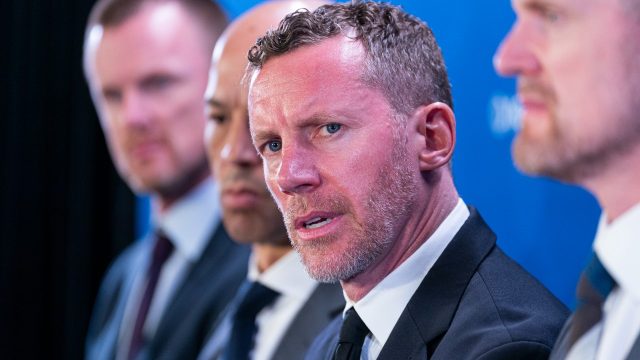
VANCOUVER — The evening before training camp opened, general manager Ryan Johnson gathered the Vancouver Canucks’ staff and players for a dinner meeting at the team’s lakeside hotel in Penticton, and then spoke the truth.
“The No. 1 thing I talked about is: ‘You have no idea how hard this is going to be,’” Johnson recalled Wednesday. “Like, ‘what you've signed up for here is almost impossible.’ You’d be ignorant... if you thought you were just going to walk in and things would fall into place. I said: ‘You’ve got to be ready because you're going to get punched in the face real quick.’
“And here we are. Game 11.”
Here they are, bruised and spiralling through an eight-game losing streak and just 2-8-1 through the start of the rebuild’s first full season.
In their last five games, Vancouver has been tied or led four times through 40 minutes and trailed (by a goal) once, then been outscored 11-0 in the third period while losing all of them.
The rebuild is not the impossible part that Johnson referred to just five weeks ago, although there is overwhelming evidence around the National Hockey League — see the Detroit Red Wings, the Canucks’ opponents Thursday — that it will be difficult.
The impossible part is believing the Canucks, under new management, with new coaches and new systems, many young and new players, and lofty organizational priorities regarding culture and environment, would somehow come out of the gate and be successful competitively against a murderer’s row of initial opponents.
In seven of their first 11 games, the Canucks have faced a team that has either won the Stanley Cup or been to the final in the last five years. And like 7-Eleven, the Canucks’ team defence has been open at all hours, surrendering an NHL-worst 51 goals.
As Johnson predicted, they have been punched in the face. And kneed, kicked, gouged and slapped in a lot of other places, too.
“This is exactly how I laid it out,” the GM said during a conversation in his Rogers Arena office, which lacks a desk, computer and whiteboard and is set up more like a cozy meeting room because Johnson doesn’t want players to feel like they’re entering the principal’s office when they walk in. “Before it gets better, it was going to get really hard, and we have to understand that.
“Look at the teams (we’re playing) and their desperation to be Cup contenders. And then we're trying to establish structure and how we're going to operate. This is what I said was going to happen.”
What he feared was going to happen?
“No, not feared because we have to go through it,” Johnson continued. “Nobody wants to win a one-off hockey game more than myself. I get it. (But) that can't be our sole focus until we get a bunch of non-negotiables in place — from our structure to our professionalism, how we speak to each other as teammates, our awareness of what a room, ground zero, is supposed to feel like. That is the hard part.
“We're 11 games in. We've said these are going to be the challenges. But we're seeing differences in some players from Game 1 to now, Game 11, taking the right steps.”
Although the losing streak is stark enough to be attracting coverage from media outlets that do sports in-person only when things are really good or extremely bad, Johnson is not worried about the losses specifically.
He likes the resilience the Canucks have shown hanging in or battling back in several games, and doesn’t believe young prospects like defenceman Zeev Buium, vital to the rebuild, are being harmed when Vancouver gets overrun by a superior opponent.
But the lopsidedness in some of the games is not healthy for anyone on the losing team, and every player on the Canucks is genetically predisposed to trying to win at all costs. (If they weren’t, nobody would want them).
So the losses, predictable or not, take a toll.
As senior defenceman Luke Schenn, a three-time Canuck and two-time Stanley Cup winner with the Tampa Bay Lightning, told Sportsnet this week: “Guys are getting unbelievable opportunities here, and you’ve got to make the most of it. Obviously wins and losses are important to every player. But I never want to be viewed... that you weren't hard to play against. I think that's probably the worst thing that you could say about a pro athlete, that you didn't make it hard on them. Myself included, we’ve all got to be much harder to play against.
“The game, as much as it's changed, it hasn't changed: it comes down to competing in one-on-one battles and taking care of the puck and winning the hard areas.”
Johnson largely agreed, and noted this is one of the key lessons for the Canucks from the first 11 games.
“It's the attention to detail of the small areas of the game,” Johnson explained. “We need to win more puck battles as a group. Those 50/50 (battles) come in so many facets of the game. It's not like we don't have a competitive group but, like I said, there's a lot that they're processing. I envisioned us being harder to play against. But I can tell guys are still at times thinking their way through a forecheck and, as you know, when guys are thinking their way through, your feet stop moving.”
Johnson said one of the most positive aspects of the Canucks’ start is the players’ attitudes coming to the rink and how hard they practise. It was an interesting subject for him to raise because poor practice habits were noted by previous GM Patrik Allvin upon his arrival nearly five years ago, and that Canuck team, undermined by dysfunction and disharmony, was eventually dismantled.
“We've been an incredibly good practice team,” Johnson said. “When the group, as a whole, continues to focus on the mornings, good things will come from it. It isn't yet second nature to the entire group. But let’s get to Game 20, and then we'll get to Game 40, and we will see. Then it’s on me, if I've got to make some decisions. But there are parts that we're not seeing (in games) that we are seeing daily in the mornings.
“A lot of these teams (we’ve played) that have been together for six-plus years, when they get kicked in the gut, they always have a foundation to go back to. We're still trying to put in the pillars. Our thing to fall back on is, like, ‘Holy s---, now what?’ But I keep saying, we're learning a tonne. You have to lose before you can learn to win. At times, it sucks.”



 5:32