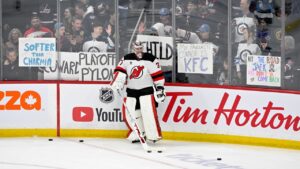
WINNIPEG — In his much-anticipated return to Winnipeg on Tuesday, Connor Hellebuyck desperately tried to keep his story straight.
But in his careful attempt to prevent his departure from Winnipeg from becoming a sticky situation, the former franchise goaltender has completely muddied the waters regarding why he abandoned the only NHL home he has ever known.
Sitting in front of dozens of reporters at Canada Life Centre, Hellebuyck looked and acted like a man wanting to have his cake and eat it, too.
Rather than speak clearly and concisely about the treatment he received from disappointed Canadians and a clear desire to move his family south of the border, Hellebuyck opted to dance around the subject.
Only adding insult to injury, Hellebuyck won't even face the music Tuesday against his former team. Despite his insistence that he felt a "duty" to play, New Jersey Devils general manager Sunny Mehta stepped in with a dizzying analytics-led excuse.
Citing a "reduction in our expected win probability," Mehta is sitting his all-star goalie. The irony of Hellebuyck demanding out of Winnipeg, where he had full control of his playing time, to join an organization that now dictates his ice time through analytics is too difficult to ignore.
But to understand just how brazen it was for Hellebuyck to sit at a table inside Canada Life Centre and ask fans to separate his exit from his legacy, you have to look at how that exit played out.
"The day I said I was a Jet for life, I meant it," Hellebuyck said. "But I also didn't foresee the future that was going to happen."
That future turned out to be a sudden and steep decline for a team that had claimed the Presidents' Trophy as the NHL's best regular-season team just a year earlier. When the Jets fell out of the post-season picture last spring, Hellebuyck's patience clearly was gone.
"I was coming off of a season where we missed the playoffs and I didn't really want to expect that to ever happen in that contract length," he said.
However, his handling of that frustration fractured the relationship he now wants to maintain.
After quietly asking for a trade, Hellebuyck watched as general manager Kevin Cheveldayoff operated at his usual, patient pace. When the Jets seemed to delay making a deal, Hellebuyck raised the stakes, going public with his trade request in August.
It was an obvious attempt to force Winnipeg's hand, and when that didn't result in a trade, he escalated the standoff further by refusing to report to training camp.
"When you make a decision like this, I feel it's got to be all or nothing," Hellebuyck said of his holdout. "I don't want to separate my family at all. If I did have to come back, it was going to be one of those scenarios where it was just me."
Rather than show up and honour the remaining five years of a contract that pays him $8.5 million per season, Hellebuyck chose to stay home. The Jets responded with a team suspension that was quietly extended into the regular season.
For weeks, arguably the franchise's greatest goalie was, quite literally, sitting in his own punishment; the suspension was set to be lifted on the exact day he was finally traded to New Jersey.
If his contract holdout was the leverage for his departure, the justification Hellebuyck shared was a clinic in serious deflection.
Several times throughout the press conference, Hellebuyck leaned heavily on his family's distress, citing unspecified examples that "crossed the line" as the reason for his trade demand. It is a sensitive subject, no doubt, and any threat to a player's family is nothing short of unacceptable.
But the way Hellebuyck used that distress while refusing to offer clarity felt calculated.
"I wanted this to be clear and that's why I don't want to try and ruin the relationship I have with the city because I'm not going to project a few moments on an entire city," Hellebuyck said. "It is more than just online death threats and I'm please going to ask you to respect my privacy and my family's privacy and I'm not going to go deeper than that."
It's an ideal argument whenever a serious accusation is immediately followed by a demand for privacy. But the timeline leaves a massive, Olympic-sized elephant in the room.
Hellebuyck's desire to leave wasn't decided in a vacuum; it started to form after he led the U.S. to a gold medal. He was publicly celebrated by U.S. President Donald Trump, who awarded him the Medal of Freedom.
When asked if that honour put a target on his back in a Canadian market, Hellebuyck didn't deny it.
"I'm sure it did a little bit," Hellebuyck admitted. "Is it fair? I don't think it matters if it's fair or not. Those are accomplishments that I will never apologize for, and I will never speak negatively about."
He added: "I would be lying to you if I said that my life hasn't changed since the Olympics and it has in a very big way."
Therein lies the frustration for many fans in Winnipeg.
It is a completely valid career choice for an American-born player to play and raise his children in the U.S., rather than navigate the "difficulties with being an American playing in Canada," as he described it. If Hellebuyck simply said he wanted to go home, it might seriously sting fans, but they would at least understand the reasoning.
Instead, when directly asked if he had any actual evidence that the harassment his family faced came from people in Winnipeg, he completely dodged the question.
"I feel like the media will eat me alive, regardless of what I say," Hellebuyck said. "So, I feel like if I answer that question, it's pinning someone against each other, and I don't want this to be about that."
The thing is you can't have it both ways. You can't point to safety concerns for the main reason you're bailing on a city, and then refuse to say if that city was actually responsible for them, all while asking the fan base to remember you for your greatness.
All of this leads to the fact Hellebuyck won't even be taking the crease tonight. Hellebuyck claimed he fought to play, adding he expected fans to wear their hearts on their sleeves.
"I went in there and said my piece and I said I felt it's my duty to play this game," Hellebuyck said.
Clearly, Mehta doesn't seem to care about his duty. The Devils' GM doesn't think the math lines up to have Hellebuyck start against his former team, not with a crucial back-to-back against division rival Washington later this week.
"I'm on a new team, I'm 14 days into a new team and they handle their business differently than I'm used to," Hellebuyck said.
Indeed, Hellebuyck appears to have traded the patience and loyalty of a franchise that discovered him, for the decision-makers that make up the Devils' analytics department. He upended his life to take total control of his career, only to get healthy-scratched by a series of underlying numbers.
None of this suggests Hellebuyck's emotions aren't genuine. He was visibly taken aback when discussing the teammates he left behind, acknowledging the pain of potentially fracturing relationships with players he essentially grew up with.
Hellebuyck has every right to prioritize his family and to chase a Stanley Cup in his home country. After all, professional hockey can be a ruthless business and Hellebuyck made a business decision.
But he cannot expect to control the fallout.
You don't get to force a messy divorce and then dictate the terms of the friendship. Hellebuyck chose his exit, but it will be up to fans to determine his legacy.
"When I retire and the day this is all over, I don't want this to be squashed, I don't want this to be ruined and our relationships to be gone," Hellebuyck said. "I'm sure it will take some time, but I'm going to choose the love I have for this city and everyone in the community."