The New Jersey Devils have had a breakout season as a team. They have been building the group through the draft and with some crafty acquisitions in trades and free agency.
And now they have another exciting young addition.
With his season at Michigan concluding Thursday night in the NCAA Frozen Four, Luke Hughes -- brother of Jack and Quinn -- made the decision to turn pro and join the Devils for the stretch drive of the regular season and playoffs.
Here’s a detailed scouting report of the present state of Hughes' game – his strengths, weaknesses, and projected role in New Jersey for the remainder of this season and beyond.
ELEMENT = OFFENCE
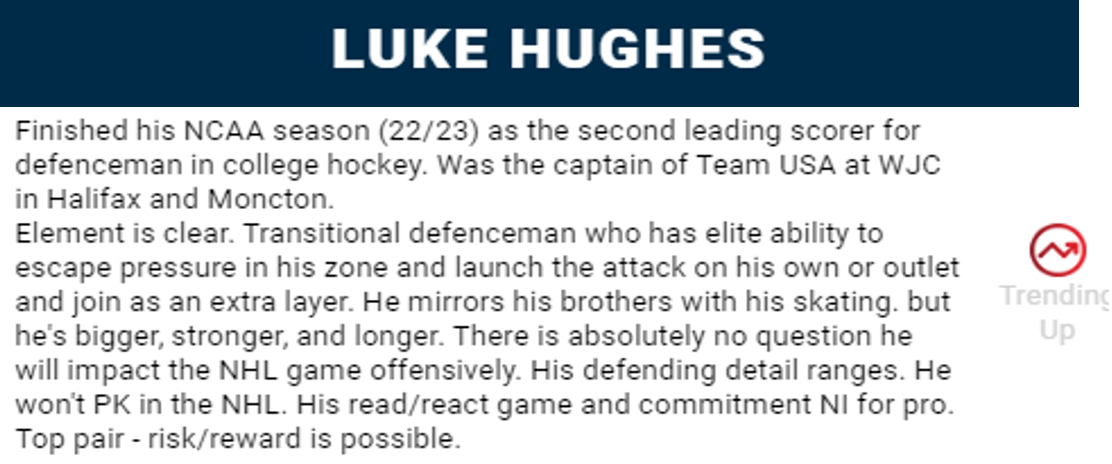
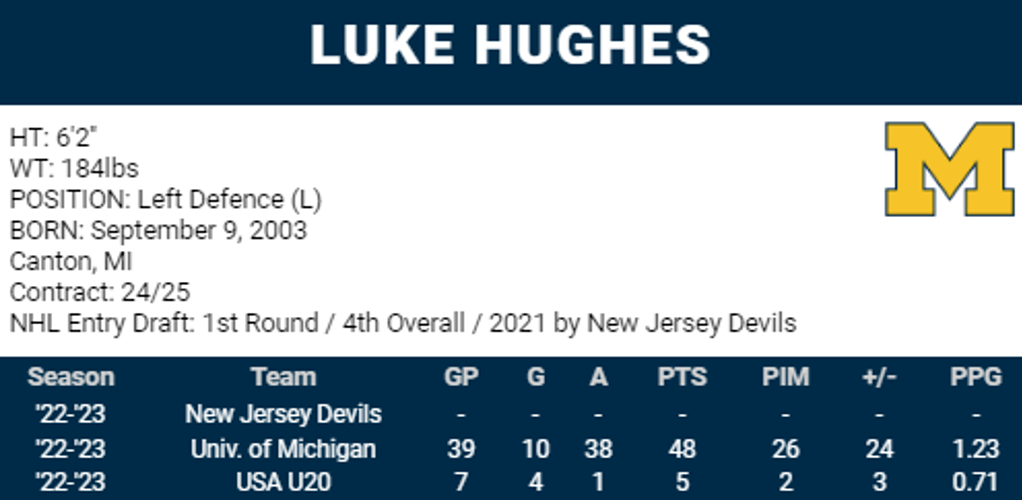
The Devils' first round pick, fourth overall in 2021, Hughes was the second-leading scorer in the NCAA among defencemen this season. He contributed an elite level of offence in both years he played at Michigan, scoring 39 points in 41 games in 2021-22.
Hughes is a fantastic skater. He’s taller than Quinn and Jack but, like his brothers, he has great edges and he’s quick out of the gate. His first three steps and agility allow him to get to pucks ahead of his opponents and launch the attack with an outlet or up-ice speed.
Here’s an example of Hughes (No. 43 on Michigan) escaping pressure with his small area skill. He outlets the puck and joins the rush as an extra layer, assisting on Michigan’s goal in the process:
Similar to his brother Quinn (Vancouver), Luke makes plays on the offensive blue line. He has elite skill and deception. It speaks to how his hockey brain is programmed offensively.
The play he makes in the following clip displays what he is capable of providing on the offensive blue line. He corrals a puck on his weak side, eludes a check, slides towards the middle of the ice, then makes quasi-no-look pass to his teammate on the right flank – leading to a goal versus Quinnipiac in the Frozen Four semi-final:
RISK/REWARD/WHAT HE NEEDS TO IMPROVE
It’s going to be tempting for the coaching staff in New Jersey to try to maximize Hughes' offensive element. At Michigan they ran set plays in the defensive zone, allowing Hughes to quarterback their attack off face-off wins. The issue isn’t going to be Hughes attacking and playing to his strengths. It’s what happens after positive zone entries that needs better attention to detail.
Here's a prime example of what I’m describing. In this clip, Michigan runs a set play for a zone exit off a defensive zone face-off. Hughes leads the rush and an offensive zone entry is the result.
Watch him closely, though. He moves to his strong side and ends up caught between pinching down to extend the play or retreating to defend. The Quinnipiac forward beats him to open space and Hughes is on the wrong side of his check. NHL scouts are on the lookout for how prospects read and react to how the play is developing in front of them. This is an area that Hughes will need to be more dialled in as a pro.
In this next clip watch how Hughes gets focused on the puck in the neutral zone. His route to defend the Quinnipiac forward in his lane is compromised in the process. He ends up gliding up the half wall in his zone and never has his check. The goal is scored from long range, but if there were a rebound Hughes would not have been in position to defend properly.
PROJECTION
There’s a saying in scouting circles “you can’t teach offence” and that is what all of the Hughes brothers bring to their teams. Luke Hughes has the ability to someday be a top pairing NHL defender at even strength and quarterback one of the Devils' power play units. I only need him to be an average defender. His offensive element wins out on projection.
NHL career projection: Top pair transitional defenceman. PP quarterback. Not likely to penalty kill
NHL Projection for duration of this season: Limited even strength minutes/power play contributor. Rare defensive zone starts. No PK/