Things have changed on the NHL calendar this season. There are two more games, for one. And with that, the season started a little earlier than usual. Normally we would use the Nov. 1 benchmark to compare seasons to one another, but this year we'll do it a little differently.
We are now 35 days into the NHL season — about two weeks shy of the official quarter mark — and that's the number we'll use when looking back at where we were a season ago.
It's obviously far too early to draw any grand conclusions about the playoffs. It is too early to play your way in, but you can start to play your way out of the post-season if early indicators don't start to improve.
But we should keep things in perspective. Thirty-five days into last season, the Buffalo Sabres sat at the bottom of the East with a conference-worst minus-8 goal differential. They ended up finishing atop the Atlantic. And in the West, Minnesota was a point out with a minus-8 goal differential — but a franchise-changing trade for Quinn Hughes was in the near future.
So while we won't sit here today and pick out which teams will, or won't, make the playoffs (although Carolina looks solidly in!), we can get a sense of some early positive and negative indicators. Here's a look at the top three in each division, plus the wild-card picture, with some notes on the good and bad we've seen.
The good
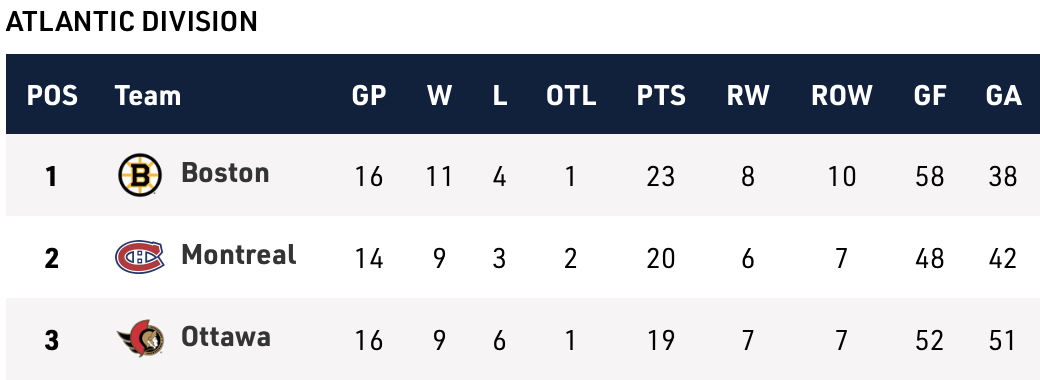
• The Bruins have a plus-20 goal differential, tied for second-best in the league behind only the Carolina Hurricanes at plus-27. Through 35 regular-season days last season, only the Colorado Avalanche had a goal differential this high (plus-22), and they went on to win the Presidents' Trophy.
• At this point last season, five teams across the league had a .700 points percentage or better, and four of them made the playoffs (New Jersey was the only one to miss). This year, another five teams are at .700 or better 35 days into the season, and the Atlantic has two of them with Boston and Montreal.
• Montreal's underlying numbers are trending better than they finished at last season. In 2025-26, this team finished with a shot, shot attempt, and expected goal share below 50 per cent, but still managed to outscore the competition by 24 goals at five-on-five. This season, they are positive in all those measures.
• The Senators' underlying numbers are still largely fine, indicating the process and the roster are solid.
The bad
• Linus Ullmark is 7-1-0 and had been performing as one of the league's best netminders before sustaining an injury. He's been out of the lineup since Oct. 21, and the Sens have posted a 2-3-1 record since then, scoring the game's first goal in three of those four losses. Without Ullmark in net this season, Ottawa's other two goalies are 2-5-1. According to MoneyPuck.com, Samuel Ersson ranks 62nd and Jonas Johansson 65th among 74 goalies in goals saved above expected.
• The Senators' plus-1 goal differential ranks last among Eastern teams currently in a playoff spot, and second-last among all playoff spot-holders in the league (Seattle at even is worse). By points percentage, Ottawa is now ninth in the East.
• The Bruins have a league-leading .942 save percentage at five-on-five, and Jeremy Swayman is the type of goalie who could sustain his play and win a Vezina. But it's also important to consider that the Bruins have allowed the most high-danger chances against of all teams currently in a playoff spot, and are 25th in the league on a per-game basis.
• Montreal had the league's 10th-best power play last season at 23.1 per cent and the fourth-best through the playoffs. So far in 2026-27, they are last overall with a 9.5 per cent success rate, scoring on just four of 42 opportunities.
The good
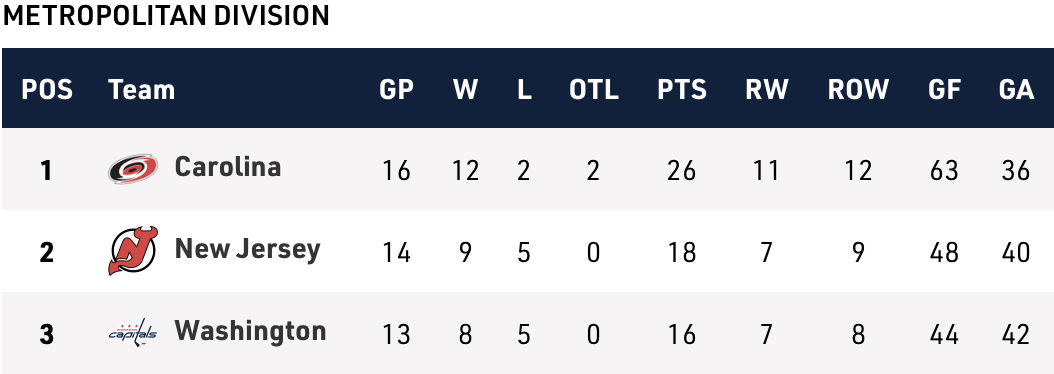
• The Hurricanes have been utterly dominant: First in the league in (five-on-five): Corsi percentage, expected goals percentage, shots percentage, goals percentage, goal differential. They even have a winning record in the second half of back-to-backs to far: 2-1.
• The Devils have similarly been running hot in many key five-on-five indicators all season, but goaltending had been keeping them back. In two starts from newly acquired Connor Hellebuyck, the Devils won two road games against tough opponents Dallas and Vegas, allowing a total of three goals against.
• Washington's depth is so phenomenal that 21-year-old Ryan Leonard is having trouble cracking the top-six after his first 20-goal season, and 22-year-old Ivan Miroshnichenko can't get in at all.
The bad
• As deep as Washington's forward group is, the blue line is less so and an area we wouldn't be surprised they tried to upgrade this season. The Capitals have the highest expected goals against at five-on-five of any Eastern Conference team so far.
The good
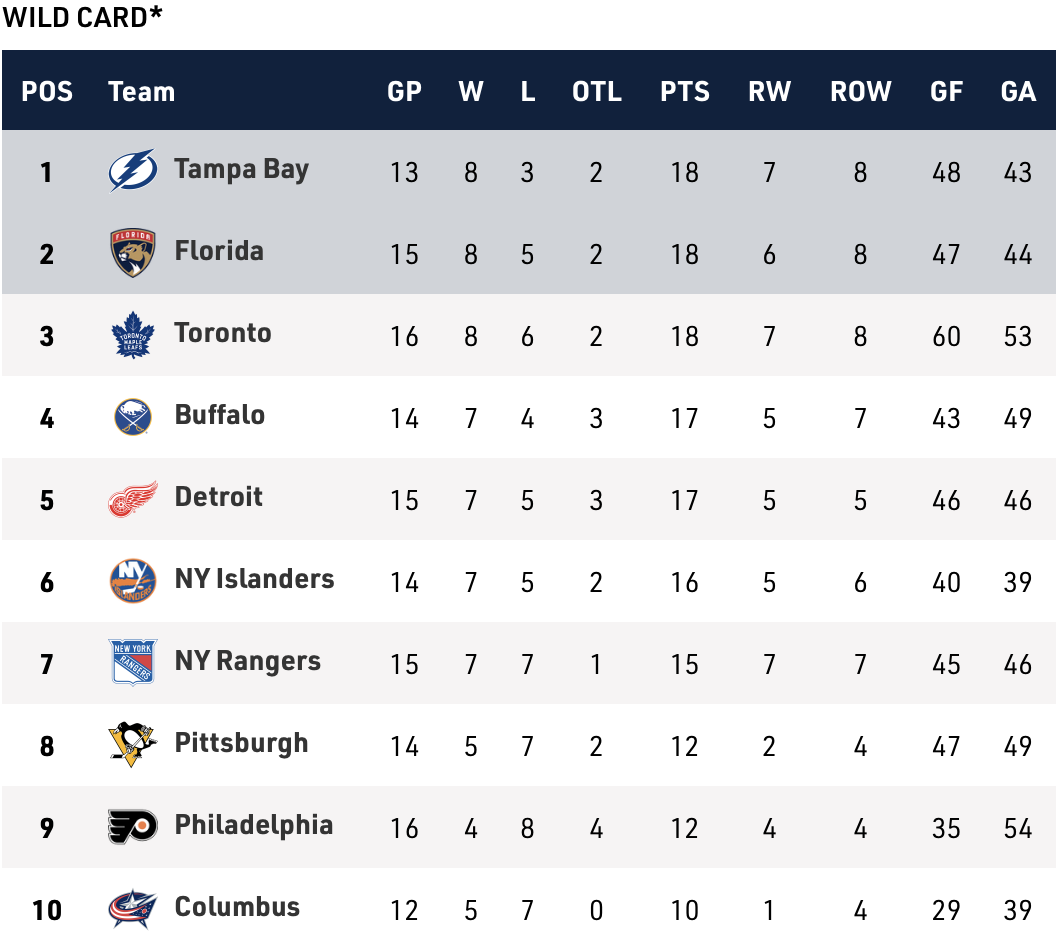
• The Sabres haven't lost a one-goal game in regulation yet, 5-0-3 in those tight contests. Are we worried about their slow start with a minus-6 goal differential? Not really. Consider that 35 days into last season, the Sabres were last in the East, 30th in the league and had a minus-8 goal differential until they became one of the best second-half teams.
• The Panthers are a defensively stout team, No. 2 overall in expected goals against at five-on-five. And after an extremely slow start, their power play has been much improved recently.
• Toronto's plus-7 goal differential is the best of any team not currently in a playoff spot.
• The Red Wings are fighting through the off-ice drama and allow the second-fewest high-danger chances in the league at five-on-five. Only New Jersey, Utah and Pittsburgh have a bigger difference between high-danger chances for and against.
• The Penguins average the most high-danger chances for per 60 minutes of five-on-five play in the league. Perhaps this will help them improve on their 13th-ranked team shooting percentage and deliver more goals in time.
The bad
• Thirty-five days into last season, the furthest any team was out of the playoffs that ended up qualifying were the Buffalo Sabres, who were last in the East and four points out. Given the third-place Metro team is currently at 16 points, every Eastern Conference team is within that margin today, except for the Blue Jackets.
• By points percentage, the Leafs are 12th in the East.
• Andrei Vasilevskiy has a well-below league average save percentage at .877. Victor Hedman is seventh in average ice time among Tampa defencemen. There is still lots of good here (three players averaging over a point per game, top 10 as a team in expected goals percentage), but these are two key veteran players — we're watching out for any further signs of decline.
The good
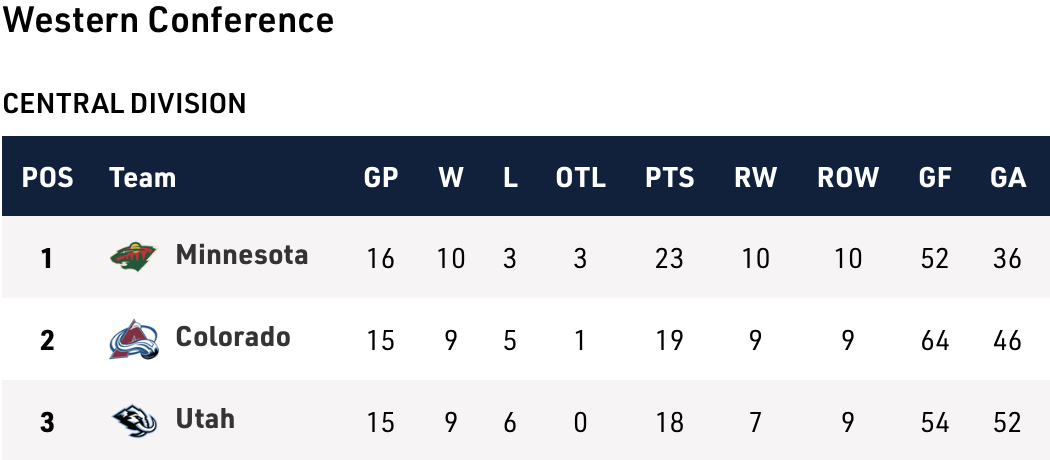
• Transition play is important in the modern NHL, and when a team on the rise like Utah can hang with a defending champion like Carolina in so many underlying metrics — including transition play — it screams sustainable breakout. Yes, Utah made the playoffs last season and took Vegas to six games, but this indicates another step is being taken.
• In Jesper Wallstedt, the Wild have a young goalie putting himself on the Vezina map early. And in Filip Gustavsson, they have the better statistical goalie from last year's team, still working his way back from off-season surgery.
• The Colorado Avalanche are scoring a pile of goals, with a league-leading 4.15 per 60 minutes at five-on-five.
The bad
• Wanted to draw attention to this interesting graphic from Mike Kelly of Sportlogiq posted just before Halloween. The Avs, a traditionally strong run-and-gun team that creates tons and allows much less, have so far this season been lumped into the "worst" category around the likes of Los Angeles and New York.
• Utah has an .858 team save percentage in all situations. That is last overall in the entire NHL.
The good
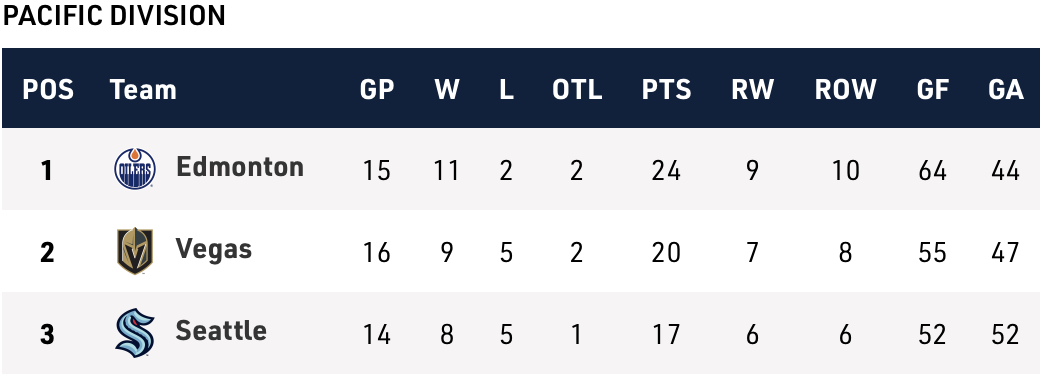
• The Oilers are simply a better, more defensive version of themselves. They now hang inside the top 10 in expected and actual goals against at five-on-five. And their power play is as dangerous as ever, clicking at 32.7 per cent.
• All of Vegas's best players are doing their thing — Jack Eichel should get Selke love, Mark Stone is once again quietly above a point-per-game player — but there is an extra layer. Vegas usually trades away its best young players, so we don't see many rookies come along. This year, however, they have Trevor Connelly going strong with 10 points in 16 games.
• How about Berkly Catton? With 11 points in 14 games, the second-year player is already closing in on his full-season totals from 2025-26. He leads the Kraken in on-ice CF%, SF%, and xGF%. There are 18 players from the 2024 NHL Draft who've played at least one game in the league this season, and the eighth-overall Catton trails only Macklin Celebrini (first) and Beckett Sennecke (third) in scoring.
The bad
• There are just so many red flags about Seattle to overlook. A too-high PDO carried by the league's second-best shooting percentage after they finished 20th in that stat last season. An expected goals percentage that ranks 29th in the league. A shots against average at 5-on-5 that ranks 31st. And an even goal differential, making them the only Western team presently in a playoff spot that isn't in the positive.
• Granted the Oilers have been battling through some injuries, but as they've loaded up the dominating top line with Connor McDavid and Leon Draisaitl, the rest of the forward group leaves something to be desired. McDavid linemate Vasily Podkolzin is fourth in team scoring (after McDavid, Draisaitl and Evan Bouchard) and the next-highest scorer after him has half as many points (Ryan Nugent-Hopkins in just six games, and Kasperi Kapanen in 15). Will being a one-line team catch up to them, or will a productive second line take shape as players return to health?
The good
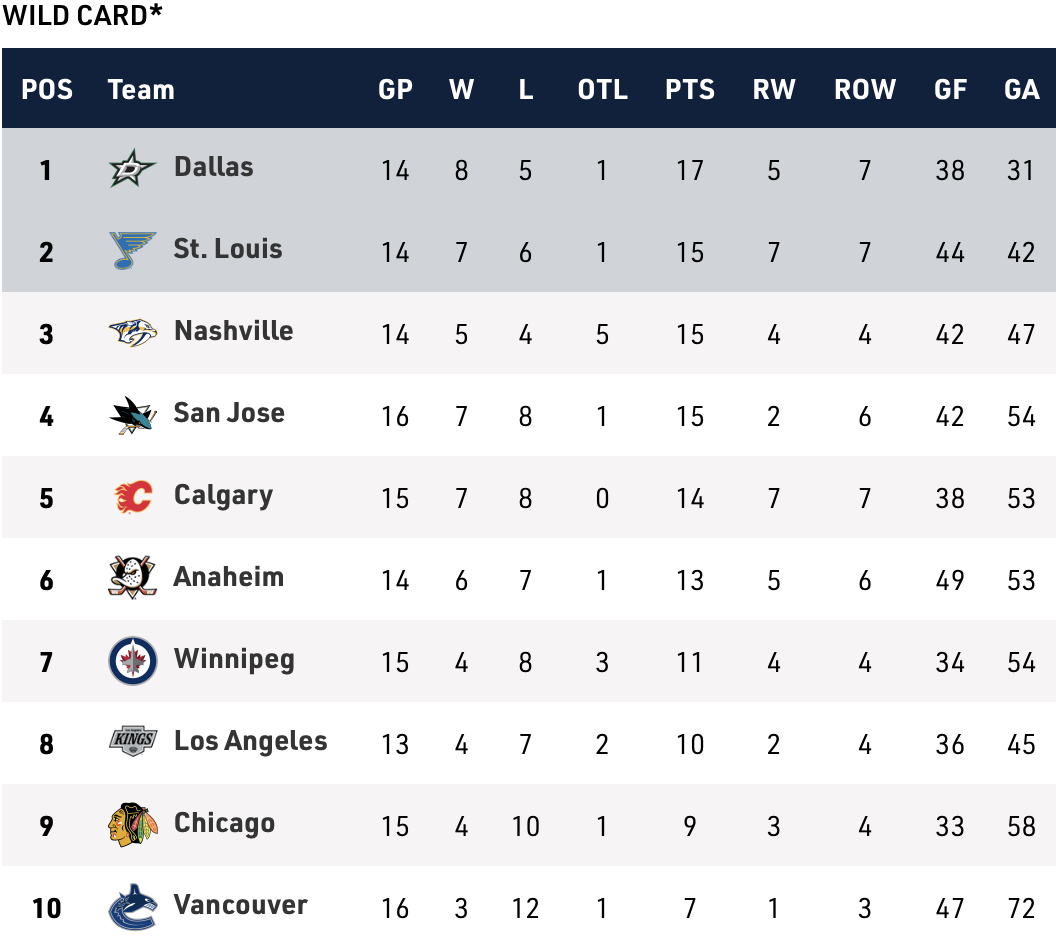
• Jake Oettinger is announcing himself as an early Vezina contender, second overall in goals saved above expected. And Dallas's defence in front of him is helping sustain that, with the league's lowest shots against per 60 at five-on-five and lowest expected goals against per 60.
• While the Kings have a lot of chasing ahead of them, they do have the league's third-best team save percentage so far. The offence has been dreadfully quiet thanks to a shooting percentage which ranks even lower than last year's when they finished 26th in the stat, but Kevin Fiala's return is on the horizon and could add something they miss.
• Maybe, just maybe, Yaroslav Askarov is turning a corner for the Sharks. His season start was just OK, but now he's allowed fewer than three goals in six consecutive starts and ranks seventh in the league in goals saved above expected.
The bad
• The Stars have become something of a low-event team, with an xGF per 60 rate at five-on-five that ranks 26th in the league — only the Kraken have a lower mark among teams occupying a playoff spot right now.
• The San Jose Sharks have scored 20 even-strength goals so far — tied for 31st in the league. Macklin Celebrini won the team's scoring title by 56 points last season, and he already has more assists than any of his teammates have points.
• Every NHL team that made the playoffs last season earned at least one point for every road game played (41). Only one Western team that achieved this missed the playoffs: Nashville. So far, Colorado and St. Louis are the only two teams currently in a Western playoff spot to fall short of that benchmark.
• Winnipeg is spiralling with nine straight losses. They remain a one-line team, and even finally breaking up Mark Scheifele and Kyle Connor for a couple games didn't help change their fortunes. If Scott Arniel is on the hot seat, will a new coach bump help?
• Thirty-five days into last season, the Blackhawks were one of the better stories with a plus-12 goal differential, and an 8-5-3 record that placed them second in the Central. The fact that they are already trailing the race so much and have the exact same minus-25 goal differential as the dreadful Canucks is not a good indicator.