For the purposes of this exercise, the divider between “is this issue fixable” or not is the question, “Does fixing this involve the need for personnel changes?” As in, for the Toronto Maple Leafs' issues, what can be fixed internally through lineup changes, system adjustments, improved play or luck, and what would require bringing in bodies from the outside to solve?
I’m calling it “fixable” if they don’t need outside help.
First, let me lay out the problems as I see them, and as the stats bear them out, then we’ll get to assessing. I’ve been making the case for weeks that the Leafs' talent level doesn't match where they currently sit in the standings — fourth-last by points percentage — and that they’re more likely a mid-range team. If their results matched their roster, they’d be closer to 20th than 30th.
Is that good? No, not great.
But at least it would’ve been, “Hey, we’re a change or two away from making the playoffs,” instead of “We need to get red hot to not give away a top-10 first-round pick this summer.”
As of today, the Leafs rank 18th in expected goals for and 19th in expected goals against at five-on-five. They have the horses for a plus power play and the defensively responsible bodies for an above-average penalty kill. Those things, plus league-average goaltending — can they get that? — sounds pretty mid-tier.
Alas, they are near the basement. Sorting this out should help determine which direction they should take in the weeks and months ahead.

32 Thoughts: The Podcast
Hockey fans already know the name, but this is not the blog. From Sportsnet, 32 Thoughts: The Podcast with NHL Insider Elliotte Friedman and Kyle Bukauskas is a weekly deep dive into the biggest news and interviews from the hockey world.
Latest episode
The Problems
D-zone entry denials and D-zone loose puck recoveries
Of all the “Yeah, that tracks” Leafs stats I’ve come across, they’re 32nd in the NHL at defending D-zone entries. That very much seems consistent with what we’re seeing. They deny entries just under 42 per cent of the time, while Boston is the league’s best with a 52.3 per cent denial rate.
What doesn’t track, to the point where I’m almost having trouble processing what’s happening, is that the Leafs are listed as having one of the smallest gap distances in the NHL at 12.1 feet on average (at five-on-five, per Sportlogiq). Only five teams are better there. The teams with the worst gaps (bottom-seven) are all non-playoff teams plus Edmonton.
Whatever the case, allowing entries against with possession at the rate they do seems like a problem they cannot fix internally. Their blueline is old and struggling, and it shows up here. They’re just not dynamic enough to close off puck carriers.
They’re 28th in loose-puck recoveries in the D-zone, and while it’s easy to say “win more battles,” I tend to think this is tied to personnel too. It’s like faceoffs. You have guys who are consistently good at it, and if the stats say you’re not great at it for a third of the season, you probably aren't.
These things should be a lasting problem unless they turn over some defencemen.
Goaltending
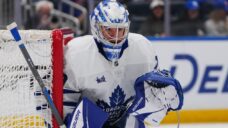
The Leafs have the 10th-worst team save percentage in the NHL, but it’s going in the right direction. Sportlogiq ranks Sergei Bobrovsky 52nd in goals saved above expected (giving up a bonus half-goal per game), but Anthony Stolarz is saving more than expected (by 0.22 per game, 20th in the league), and he’s playing more, so as long as he’s healthy, they should continue to see better results there.
Bobrovsky has been held out of the net for a bit, and the goal is for him to rediscover a better version of his game. He’s been particularly bad on “unscreened shots,” where the Leafs combined save percentage is the worst in the league (according to Money Puck). Can he find a few more of those saves after some time off to regroup?
With simply more Stolarz starts and a better Bob — even marginally — they should move closer to the league’s middle than the basement.
No rush play, no screens, little offensive depth
The Leafs have skilled players, and that's probably why they’re fourth in the NHL at gaining control of the blue line. But the rushes aren’t that threatening, as evidenced by the fact that they’re 29th in rush chances for. They’re mostly carrying it in against a defence with numbers back, though the return of Kirill Marchenko (and Jack Roslovic) should really help. Health alone should help them generate more rush chances.
What worries me, and seems likely to continue, is that the Leafs are 30th in the league at generating shots with screens, which get you the type of “easy” looking goals where someone just shoots it in the net, as Jake McCabe did against the New York Islanders on Monday night. They just don’t have a lot of guys who love to play there, but more than that, they don’t have the type of D who can generate point shots from touches, because they can’t walk the line like elite or even good NHL defencemen. It’s too bad, because they’re 9th in the NHL at generating cycle chances, which would mean a lot more if their D could take advantage of their good offensive-zone play.
I think this is an area that remains a problem.
Coaching
One area has been killing them: allowing good chances (and lately goals) off lost defensive-zone draws. Teams know they play man-on-man, so they run winger-over plays and D-down the wall, knowing the Leafs will have a defender get caught on the “pile” (where the centres meet up and hold ice), which creates space. Some 20 per cent of the time — a bit more actually — teams are getting slot shots off these defensive-zone losses. That ranks 31st in the NHL and is, frankly, atrocious.
This is either a simple toggle to a more zone-based structure off those lost draws, or it just requires some practice time to show the wingers they need to go under the centre pile rather than over. This is an easy coaching fix to at least bring it to league average.
I get the sense that Jim Hiller is open to adapting (frankly, I think it’s part of what made him appealing to this management group). Most of what they’ve tried hasn’t worked so far. With that, I expect things to change, and that alone could help results a bit.
That said, we haven’t seen him make any confident changes as of yet, so this part remains to be seen.
The horse has left the barn on stuff like accountability, given how William Nylander has played while still playing plenty. They don’t have an identity, and it feels like true leadership will be tough to establish now. It’s a real challenge for the team as they try to work their way out of the cellar.
Overall
One nice thing about their D-corps struggling so much is that it doesn’t take a massive overhaul to get even a little bit better. But we’re talking about internal gains here, and it’s tough to see them get a whole lot better over the coming months without doing that. They’re stuck there, and stuck in goal, so they have to bank on veterans using their savvy to play better.
Some health up front should help a lot (they were much, much better when Kirill Marchenko was in the lineup), and the coach should make some changes.
I can see a stretch of play coming where they put up more wins than losses and work their way back to being respectable. But the hole is too deep, and if you’re making a real assessment of the group, they need outside help to do anything more meaningful than that.
How much help they need — is that a Big Dawg fire sale and a fresh start? — well, that’s a different conversation entirely. But barring that massive decision, they’re looking at a ceiling that’s pretty mid, which, at this point, is probably an outcome fans watching this November would be thrilled to see come through.