At the very end of his Board of Governors’ media conference last month on the 101st floor of 30 Hudson Yards in Manhattan, NHL commissioner Gary Bettman offered an unprompted forewarning on the future of hockey’s salary cap.
“Somebody had asked about the cap going up,” Bettman jumped in.
“Please keep in mind that the cap going up at the rate it’s going up, it’s still a function of recapturing where we’re supposed to be after years of a flat cap,” Bettman said. “That number continues to be [managed] as we try to create a smooth increase in cap and not drive everyone crazy by who happened to be a free agent in a year with a huge jump.”
Bettman reminded that once the system recaptures it, which he estimated “it will take two more years give or take,” then the cap “will go up at the same rate as revenues grow.”
Fortunately for Bettman and the NHL, revenue continues to climb at record rates.
But that means the salary cap will require even more finessing to smooth out drastic increases – because the cap is being kept so artificially low this season that there is a pending explosion.
According to projections run by Sportsnet, verified by multiple team, league and Players’ Association sources, the NHL’s salary cap ceiling could reach $150 million USD by 2029-30 – just three seasons from now. That is a whopping 44 per cent increase from this season’s ceiling of $104 million.
How did we get here?
The calculation is relatively simple and we can use crumbs of information from Bettman’s media availability. He said last month that this season’s projected revenue was “just north” of $8 billion, or $8 billion “and change” in “mixed currency” since the league’s teams earn revenue in American and Canadian dollars.
Sources said the league internally has that projection at $7.1 billion USD plus $1 billion CAD. Based on today’s exchange rates, we can conservatively say that means total projected revenue for this season is $7.7 billion USD.
Armed with that information, we can then calculate that this season’s unadjusted salary cap ceiling would be approximately $128 million.
So, why is the NHL’s salary cap ceiling only $104 million this season and not $128 million?
You’d have to go back to the pandemic and the Collective Bargaining negotiations that followed, where the NHL and NHL Players’ Association instituted a two-year ‘lag’ formula, which was a departure from standard cap calculation. Essentially, the two sides agreed that with revenues disrupted and a flat cap necessary so players could repay owners for wages taken in shortened seasons, for a period of time the cap would be calculated based on a look back of revenue from two seasons prior, not the current year’s projection. It was a function designed to save players from parking significant chunks of their cheques in escrow.
Nearly two calendar years ago, shortly after the Colorado Avalanche traded Mikko Rantanen in Jan. 2025 fearing they’d be unable to fit his next contract under the cap, the NHL and NHLPA released an unprecedented three-year look ahead of salary cap projections.
It called for the cap to rise from $88 million to $95.5 million in 2025-26, then $104 million this season, followed by $113.5 million next year.
Everyone was happy. Players were thrilled to see the cap meaningfully rise after six seasons of it stalling. Owners were thrilled with measured increases that would save their spend-happy GMs largely from themselves.
There is just one problem: the salary cap figures agreed upon are mostly arbitrary.
Because at the end of the day, the CBA calls for the NHL and NHL Players’ Association to divide the total pot of hockey-related revenue equally at 50/50. Despite whatever players take for pay in contracts, final accounting balances the split equitably – which was the function of the players’ hated escrow payments.
Escrow payments have been a thing of the past for three seasons now. In fact, the system has swung so far in the other direction that players are now drastically underpaying themselves.
Multiple sources told Sportsnet that NHL players are currently tracking to receive a top-up payment of seven per cent above their contract’s face value for this season. That’s because NHL players are only going to be paid approximately 43 per cent of the 50 per cent they are owed of the total revenue pie.
That might sound good for players, but the feeling is like getting a large tax refund cheque – it’s nice to have the money but it means you gave the government an interest-free loan when it could’ve been in your pocket the previous year. The same holds true here: an artificially lower salary cap is suppressing player salaries.
That is the true reason why we saw players’ salaries cross the $20 million per year threshold last summer, because teams and agents have begun to project out the increases relative to revenue and understand that in the very near future these large contracts will become the going rate. Based on the conversations we’ve had, there are some teams that have still not fully grasped the looming increases:
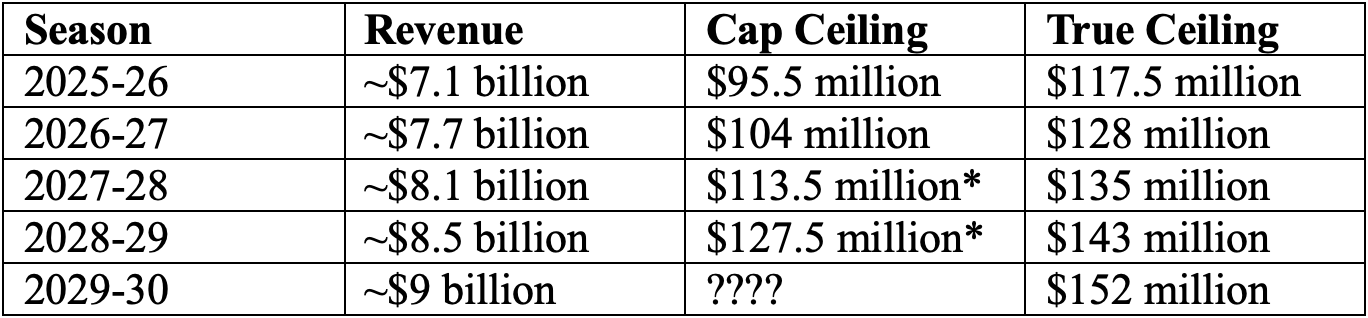
Assumption: 5 per cent growth in revenue year-over-year. Historical average is closer to 7 per cent. *denotes projection supplied from NHL to teams.
All of this means that there is a possibility the NHL and NHL Players’ Association agree to renegotiate next season’s projection of $113.5 million upward. Bettman advised teams in that September meeting that the projection for the 2028-29 season is $127.5 million. That alone is a $14 million increase in one summer. Adjusting next season upward will smooth two seasons from now, reduce the players’ underpayment, and help for when revenue is re-linked.
Put simply, it’s something the NHLPA in particular should be pounding its fist on the table to see, as every player benefits from a rising cap. There is a sweet spot to find where players are projected to see a minimal one or two per cent end-of-year top-up payment that would prevent escrow from ever being withheld from their paycheques again.
Of course, the projections are merely conservative. If league revenues trend closer to the historical seven per cent increase as opposed to the five projected, the cap jumps will be more pronounced. If an expansion team enters the fray, a few hundred million more dollars from the hockey-related revenue it would generate will be thrown into the pot each year, further jacking up the cap.
That is one reason why not every club is in favour of expansion. Smaller Canadian markets earning in Canadian dollars cannot increase pricing quickly enough to match the rising cap spending in American dollars – not with a potential cap three seasons from now at north of $210 million in Canadian dollar equivalent.
These are good problems for the NHL to have, it’s a lot easier to stickhandle around growth than to be desperate to dig up more.
“Only goodness comes from growth,” said Capitals owner Ted Leonsis, newly elected chair of the Board of Governors. “There is no stasis, you’re either growing or you’re shrinking, and every day you’re in a battle for mind share and market share and bringing in new dollars. The cap growing is a positive sign for everybody. We’re going to continue to be a growth stock.”