
In December of 1981, the champions of Europe were given a footballing lesson.
Just 12 minutes into that year’s Intercontinental Cup match in Tokyo, Liverpool was cut open by a searching Zico ball that caught out Alan Hansen before landing at the feet of Nunes, whose right-footed stab beat goalkeeper Bruce Grobbelaar to the far corner and put Flamengo in front.
Then, shortly after the half-hour mark, Grobbelaar spilled Zico’s free-kick, allowing Adílio to double the Brazilian side’s advantage. And just six minutes later Flamengo was 3-0 ahead—Zico’s no-look pass having sprung Nunes to scamper in on goal uncontested.
Having lifted a third European Cup in five seasons only seven months prior—and having kept clean sheets in each of those finals—Liverpool had been systematically dissected by a South American side that cruised to victory in the second half.
“I have no explanation for it,” remarked Liverpool manager Bob Paisley following the defeat. “I simply cannot understand it.”
He added, with a hint of an excuse: “We were beaten by a better side whose superior technique gave them an advantage on that kind of pitch.”
The surface, it seems, had been bumpy. Goodness knows there weren’t any of those in England in the 1980s.
2014 FIFA Club World Cup
The Europeans, it seems, have never quite come to grips with the competitiveness of their global counterparts at club level.
Each of Europe and South America has won 26 of the 52 instalments of the now-retired Intercontinental Cup and modern FIFA Club World Cup. And while many in the UEFA region may like to think the club game tops out at the Champions League they forget a fundamental tenet of the sport: that football is both upwardly and downwardly mobile; that the extrapolation of this logic leads to an inarguable conclusion—an international champion.
Corinthians, who won the 2012 Copa Libertadores (the South American version of the UEFA Champions League), are the present Club World Cup holders, and their 1-0 win over Chelsea last year in Japan ended a five-year spell of European dominance.
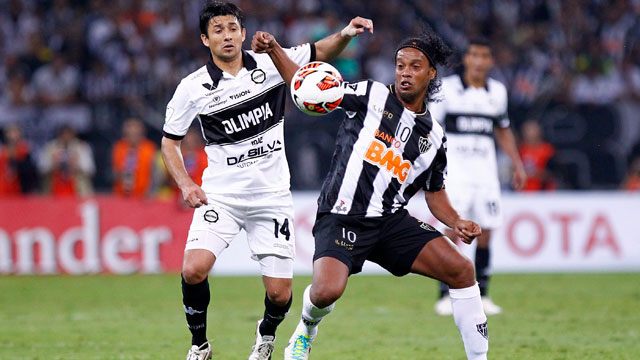
But O Timão crashed out of the 2013 competition at the Round of 16 and Brazilian rivals Atlético Mineiro went on to win this year’s tournament, beating Paraguay’s Olimpia on penalties.
They’ll be joined at this month’s FIFA Club World Cup by Oceania champions Auckland City, CONCACAF representatives Monterrey, African Champions League winners Al-Ahly, Asia’s Guangzhou Evergrande and host side Raja Casablanca.
Europe, meanwhile, will be represented by Bayern Munich, and given the Bundesliga outfit’s ongoing dominance it’s a good bet the Club World Cup will fall back into UEFA possession in Morocco.
The particulars
Hosts: Morocco, in two cities—Agadir and Marrakesh.
Dates: December 11 to 21
Format: Raja Casablanca, the Moroccan champion, will face Aukland City in a playoff, and the winner will progress to a quarter-final against Monterrey. Guangzhou Evergrande will battle Al-Ahly in the other quarter-final. Atlético Mineiro and Bayern Munich have been seeded in the semifinal round, where Bayern will take on the Guangzhou Evergrande-Al-Ahly winner. The final will be played on December 21 at the 45,000-capacity Stade de Marrakech.
Raja Casablanca (Morocco)
Participation: 2nd Club World Cup.
Qualification: Botola Pro champions, finishing four points clear of FAR Rabat.
Manager: Faouzi Benzarti, a former Tunisia manager.
Key players: Mouhcine Iajour led Raja Casablanc in scoring last season; striker Déo Kanda was acquired from former Club World Cup finalist TP Mazembe in July.
Auckland City (New Zealand)
Participation: 5th Club World Cup and 3rd in succession.
Qualification: OFC Champions League winners, beating Waitakere United in the final.
Manager: Ramon Tribulietx, former Auckland City player now in his fourth season at the club.
Key players: England’s Adam Dickinson and Papua New Guinea’s David Browne will be counted on to score the goals; captain Ivan Vicelich has been capped 88 times for New Zealand.
Monterrey (Mexico)
Participation: 3rd Club World Cup and 3rd in succession.
Qualification: CONCACAF Champions League winners, beating Santos Laguna in the final.
Manager: José Guadalupe Cruz, the Atlante coach at the 2009 Club World Cup.
Key players: Chilean striker Humberto Suazo will lead the line; Neri Cardozo and Jesús Zavala will work an effective midfield.
Guangzhou Evergrande (China)
Participation: 1st Club World Cup.
Qualification: AFC Champions League winners, beating FC Seoul in the final.
Manager: Marcello Lippi, formerly of Juventus and Italy, who he guided to the 2006 World Cup.
Key players: Elkeson led the team in goals last season; Muriqui was top-scorer in the Champions League. Both are Brazilians.
Al-Ahly (Egypt)
Participation: 5th Club World Cup and second in succession.
Qualification: CAF Champions League winners, beating Orlando Pirates in the final.
Manager: Mohamed Youssef, a former Egypt defender who earned 51 caps for his country.
Key players: Mohamed Aboutrike scored five Champions League goals and is one of the best African footballers of all time; Emad will lead the line in attack.
Atlético Mineiro (Brazil)
Participation: 1st Club World Cup.
Qualification: Copa Libertadores winners, beating Olimpia in the final.
Manager: Cuca, a former Grêmio and Real Valladolid striker.
Key players: Ronaldinho scored four goals and assisted on seven others during Atlético’s Libertadores run; goalkeeper Victor was nothing short of heroic against each of Tijuana, Newell’s Old Boys and Olimpia; Brazil striker Jô will look to do the damage up front.
Bayern Munich (Germany)
Participation: 1st Club World Cup.
Qualification: UEFA Champions League winners, beating Borussia Dortmund in the final.
Manager: Pep Guardiola, who won three La Liga titles, two Champions League crowns and two Club World Cup championships during his time at Barcelona.
Key players: Franck Ribery is a Ballon d’Or finalist and one of world football’s best playmakers; Arjen Robben bagged a brace in last May’s Champions League final; Toni Kroos is the metronome that keeps Bayern ticking along.
Jerrad Peters is a Winnipeg-based writer. Follow him on Twitter.