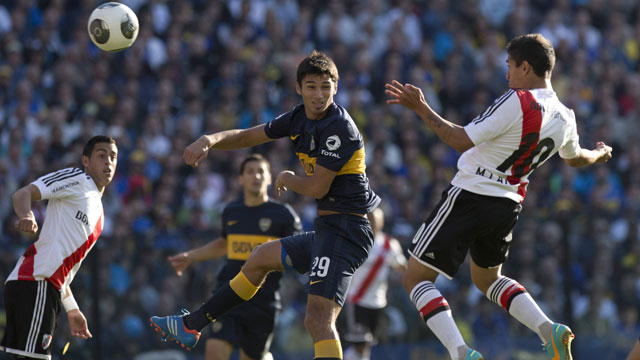

This is an immigrant story, a tale of those who made it and those who didn’t.
It is the social fissure of South American soccer, begun in and around the La Boca section of Buenos Aires and transported north out of Argentina in the first half of the 20th century.
It is River Plate and Boca Juniors, and the template of this city, national and socio-economic derby known as El Superclásico has been replicated throughout the continent since its inception.
 Sunday programming alert: Watch River Plate vs. Boca Juniors in the Superclásico live on Sportsnet 360 and Sportsnet World. Coverage begins at 5 pm ET/2 pm PT. You can also watch live on Sportsnet World Online | TV schedule
But it all began in La Boca, which is where our story begins.
Situated at the mouth of the Matanza-Riachuelo river and shaped like a letter "P," La Boca is the neighbourhood where immigrants to Argentina — many from Italy — set up their impoverished, albeit colourful, barrio upon arrival in Buenos Aires. The neighbourhood standard incorporates the St. George’s Cross in recognition of its ties to Genoa, and in 1882 it attempted to separate from the rest of the country.
But its winding patchwork of multi-coloured cityscape is best known for its soccer, as it’s here that both River Plate and Boca Juniors got their starts.
The inaugural First Division match between the two sides was contested in August 1913 (the Centenary was celebrated during a riotous affair last May that was delayed for 15 minutes while police attempted to douse the violence that had flamed up at La Bombonera, Boca’s stadium) and both teams continued to represent the neighbourhood for the next 10 years until River moved north to Nuñez.
It was a relocation that would come to define this derby, and the animosity inspired by it has hardly receded in the 90 years since.
Affluent and up-market, Nuñez was a planned barrio — organized and inviting where La Boca was jumbled and hardscrabble. These days it’s a construction zone for luxury condominiums, and its streets pass by fancy villas, fashionable shops and spacious city parks. It is where the immigrants of a hundred years ago aspired to live; it is where River managed to transplant itself.
And so we have a derby that replicates the fracture of a city, a country and a continent.
As South American soccer expert Tim Vickery told this writer some time ago, "It’s the story of the masses. The fault line that we have in the River-Boca game is replicated in the main derbies all over South America. In very crude terms it’s the ‘haves’ versus the ‘have-nots’."
And at times it has turned ugly.
In a June 1968 Superclásico, 71 fans perished in a stadium disaster known as Puerta 12. Both clubs blamed the other’s supporters for the tragedy at River’s Estadio Monumental; both also named the police among the culprits. A follow-up investigation failed to accomplish much of anything.
More recently, last May’s encounter between the archrivals was marred by crowd disturbances that caused a quarter-hour delay in the second half while police tried to impose some control over the situation. At points players became the targets of flares and a section of fans scaled the fence separating their standing section from the pitch. They were eventually repelled by water-cannons.
The raucous match-day atmosphere of the Superclásico was included in the derby stencil the Argentines exported throughout South America during the first half of the last century.
"The English brought football to the south of the continent and it spread north later on," Vickery explained. "It’s the Argentines who did that pioneering. Argentina was the driving force in the popularization of the game. All across the continent people picked up on the fan chants from Argentina, and also the template of this big derby."
It’s a derby that has hardly calmed over time.
More than a hundred years on its jealousies, condescensions, and general loathings are very much alive — still woven into the fabric of a match where history, reality and general enmity are front and centre at least twice each season.
Superclásico news and notes
Jerrad Peters is a Winnipeg-based writer. Follow him on Twitter.