
NOTE: This story originally appeared on Sportsnet.ca on Oct. 4, 2013.
There is nothing like El Superclásico in world soccer.
Nothing.
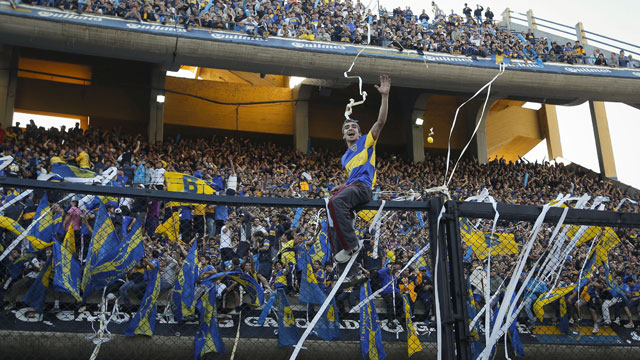
The Buenos Aires derby between eternal rivals River Plate and Boca Juniors has all other derbies beat when it comes to intensity, fan atmosphere and visceral emotion. It’s Real Madrid vs. Barcelona, only on steroids. It’s Rangers vs. Celtic, only with, you know, two quality teams. It’s Inter vs. Milan, only with 10 times the hatred.
Sunday programming alert: Watch Boca Juniors vs. River Plate in El Superclásico live on Sportsnet World. Coverage begins at 5 pm ET/2 pm PT. You can also watch live on Sportsnet World Online | TV schedule
Think this is just hype and hyperbole? Well, consider that the Guardian put El Superclásico at the top of its list of 50 sporting things you must do before you die.
“Derby day in Buenos Aires makes the Old Firm game look like a primary school kick-about,” the Guardian said in a 2004 feature article.
The BBC once described this derby as “a sea of colourful flowing banners, screams and roars, chanting, dancing and never-ending fireworks.”
Still don’t believe it’s a frenzied and fierce affair contested between two sets of blood-thirsty fans? Maybe this will change your mind:
Why is there so much animosity between Boca and River? Well, the rivalry dates back more than a century to their first meeting in a friendly played on Aug. 2, 1908, so there’s plenty of history. But there are also socio-economic factors at play here.
Boca and River have their origins in La Boca, the working class barrio of Buenos Aires where both clubs were founded in 1901 and 1905, respectively. However, hostilities were heightened in 1925 when River moved to the affluent district of Núñez in the north of the city. Ever since, Boca has been the club of “working class” folks, while River Plate is seen as the team of the upper-class, and has been dubbed Los Millonarios.
Boca fans call River supporters gallinas (chickens), suggesting that River players lack guts. River fans refer to their Boca counterparts as los chanchitos (little pigs) because they claim La Bombonera, Boca’s home stadium, is located in a smelly part of town.
It’s interesting to note that both clubs draw fans from all social classes, but why let that disrupt the nifty narrative, right?
For more on the history of the derby, check out Jarred Peters’ piece for sportsnet.ca.
Okay, okay. So they’re two South American clubs who hate each other. But what about the actual soccer? How good could this rivalry actually be? Well, considering we’re talking about two of the biggest clubs in all of South America, the quality of soccer on display is quite something.
The list of legends who’ve played in this affair reads like a who’s who of the game, and notably includes Diego Maradona, Mari Kempes, Gabriel Batistuta, Daniel Passarella and Hernan Crespo.
Maradona? Really?
Yep. Before he moved to Europe in the early 1980s, Maradona was a star at Boca Juniors:
Oh, and there’s one more thing.
The Superclásico has become such a sporting and cultural phenomenon that it inspired a 2011 Danish film of the same name. Directed by Ole Christian Madsen, it’s a campy comedy that tells the story of a Copenhagen wine dealer who flies to Buenos Aires to win back his wife, an aging soccer agent who left him and is living with a young Boca Juniors player.
No, really. That’s the plot. Honest: