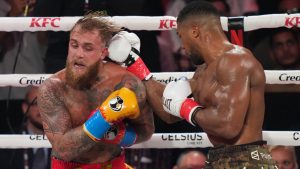
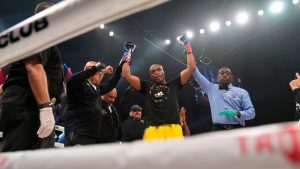
UFC broadcasts are, if nothing else, consistent.
CEO Dana White has always prioritized how UFC events look and feel, both for the home viewer and those in attendance.
“Whatever is going on inside the Octagon, I can’t control,” White told Forbes earlier this year. “I’m looking at the broadcast and things that I like and don’t like. My team is so freaking good, there’s a red phone, very rarely do I have to pick up that red phone and do anything.”
If there is one event in the modern era of the promotion that felt different, it was last year’s UFC 306 (the organization's 2024 Noche UFC event) at The Sphere in Las Vegas, which took production to another level with a “one night only” feel and recently won two Sports Emmy Awards for Outstanding Studio or Production Design/Art Direction, and Graphic Design - Specialty.
I had the privilege of being in attendance for that event and was seated on the floor for the main event between then-bantamweight champion Sean O’Malley and current champion Merab Dvalishvili, who went on to defeat O’Malley that night to capture the title.
When watching live fights, I do my best to score them in real time. Having passed an Association of Boxing Commissions mixed martial arts judging course, I am, to the best of my abilities and education, attempting to watch while being mindful of the scoring criteria.
On that night, those abilities were admittedly not as sharp as they typically are because my priority was to soak in the pageantry of this “one-of-one” event at one of the world’s most unique and incredible venues, which has little in common with the type of sports arenas where UFC events are typically held and is utilized as a theatre for essentially every other event.
When the rematch between Dvalishvili and O’Malley was announced earlier this year, my immediate thought was I needed to re-watch it in a more controlled environment to score it with a discerning eye.
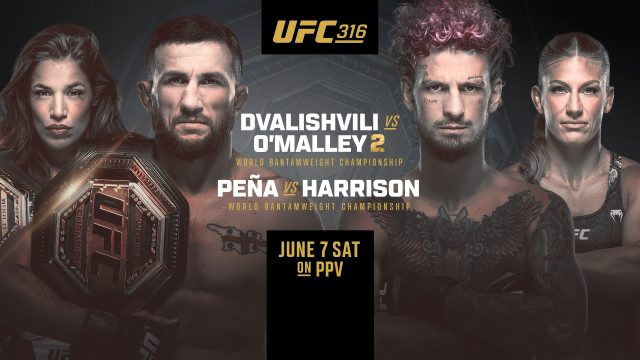
Watch UFC 316 on Sportsnet+
Merab Dvalishvili and Sean O’Malley meet in a championship rematch and Kayla Harrison challenges Julianna Pena for the women’s bantamweight title. Watch UFC 316 on Saturday, June 7 with prelim coverage beginning 8 p.m. ET / 5 p.m. PT, and pay-per-view main card starting at 10 p.m. ET / 7 p.m. PT.
Purchase the event
On the night of the event, I had scored the fight 48-47 Dvalishvili with him winning Rounds 1, Rounds 2 and Rounds 4 and I recall there being pushback because of how dominant Dvalishvili looked, with many believing the gap was larger.
O’Malley himself stated that upon rewatch, he felt that he won the first, third and fifth rounds and had won the fight.
Judging fights in real-time is a difficult task and one that will invite detractors who are watching a broadcast that provides them with the best angles, commentary and instant replay, which are luxuries that the three credentialed judges sitting cageside often do not have at their disposal. This can be a good thing because it will remove any sort of bias and with the judges sitting at three unique vantage points, if one judge misses a small nuance, the goal is for the other two judges to have caught it from a different vantage point.
Recently, there was an account on X that caught my eye with the handle @Judgeanalyzer. After each round, they would post their second-by-second analysis with both a unique numerical score as well as how they scored the round based on MMA's "10-point must" scoring system.
My first thought was that this was an account that analyzed MMA judges, but after speaking with the account’s owner, Patrick Lingenfelter, I learned that he was actually a judge himself that created the MMA Judge Analyzer tool to help him accurately score rounds in real time and provide a log that displays how he got to those tallies.
Lingenfelter’s bio on the California Amateur Mixed Martial Arts Organization website states his credentials as a licensed Judge in California, Arizona, Wisconsin and Minnesota and he has judged both amateur and professional MMA (in addition to other combat sports).
His account is a great resource to see how a certified judge is scoring major fights in real-time with the sole focus being on the scoring criteria.
In revisiting the first bout between O’Malley and Dvalishvili, I opted to use the MMA Judge Analyzer tool and asked Lingenfelter if he would be comfortable re-scoring the fight with me so that we could compare our tallies after the fact.
Lingenfelter obliged and after re-watching the fight, here is how we scored each round with a brief explanation as to why, plus some select samples of the MMA Judge Analyzer tool, which has both a desktop and mobile version.
ROUND 1
Bronsteter: A much closer round than I remember it being. Ultimately, Merab is the busier fighter and while much of what wins him this round in the eyes of the public comes down to him controlling O’Malley, it is what he does with his control that matters, which is landing significant strikes along the way while neutralizing the attack of his opponent in those moments. 10-9 Dvalishvili.
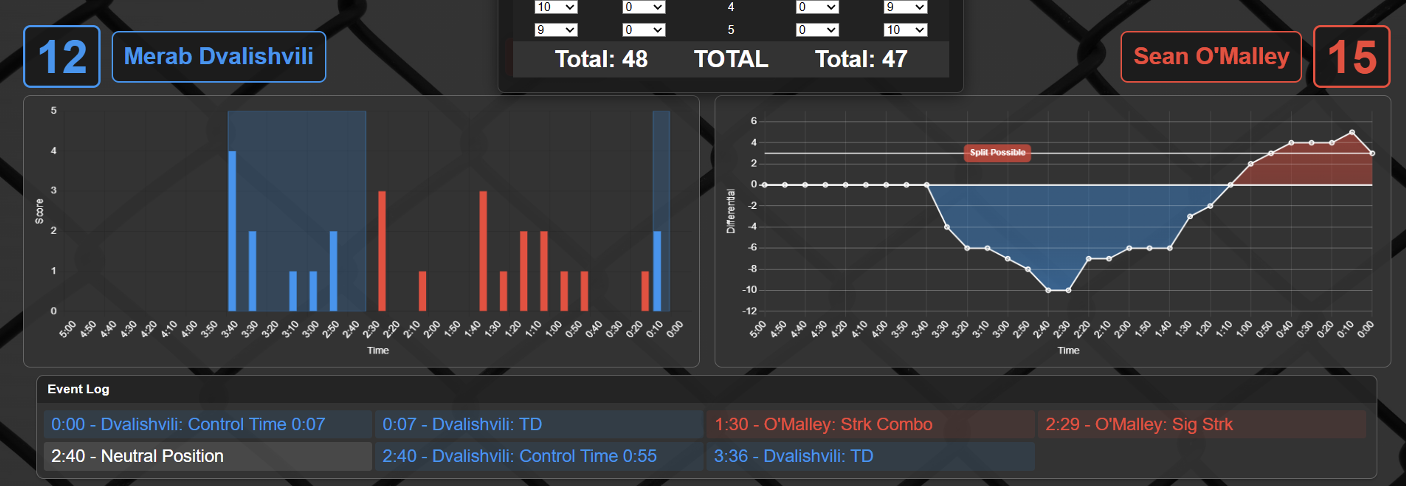
Lingenfelter: The round was basically the tale of two halves. O’Malley had the striking advantage early, even landing what I would call a significant strike at 2:32 that further damaged and bloodied the face of Merab. Shortly after that punch at 2:06 Merab gets his first takedown where he landed multiple knees to the legs of O’Malley causing immediate and cumulative impact. O’Malley gets back up at 1:22 but is taken down again at 0:55 where not only does he get credit for the takedown but also puts O’Malley in a guillotine choke at 0:48 that O’Malley has to avoid going to his back and almost giving Merab the mount. This is the second grappling sequence that sealed the round for Merab. They get back to their feet at 0:21 but nothing lands with any significance after that. 10-9 Dvalishvili.

ROUND 2
Bronsteter: A very clear round for Dvalishvili. He takes O’Malley down and makes his life miserable for much of the round. Easy round to score. 10-9 Dvalishvili.
Lingenfelter: This was obviously a dominant round but seems even more dominant because of Merab’s antics. He also used this tactic to show a perceived advantage in Round 3 of his January title defence against Umar Nurmagomedov. This becomes an issue with judges versus public opinion because you don’t score those antics. They give the fans and commentators something to talk about but this could be manipulated if you let it bleed into the credit you are giving for impact techniques. 10-9 Dvalishvili.
ROUND 3
Bronsteter: This was the only round on which the three cageside judges didn’t unanimously agree. One judge gave the round to Dvalishvili but I lean with the two scoring it for O’Malley, who wins by a narrow margin with the most meaningful offence being landed in the final minute of the round. 10-9 O'Malley.
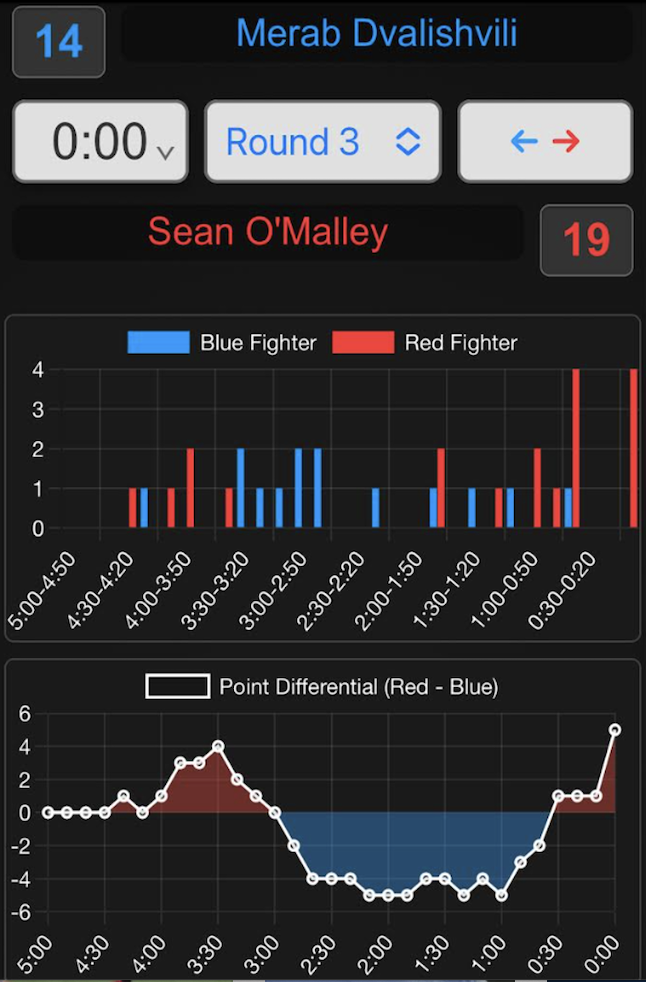
Lingenfelter: I basically had the sequence from Merab from 3:30 to 2:40 vs. 1:00 to the end of the round for O’Malley. I had this going for Merab the first time that I scored this, but it’s a close round that in my opinion could go either way. 10-9 O'Malley.
ROUND 4
Bronsteter: Another clear Dvalishvili round, where he fully neutralized O’Malley, limited his opponent’s offence, while landing high output throughout. While it is a clear round for Dvalishvili, it does not satisfy the requirements for a 10-8 round, in my opinion. 10-9 Dvalishvili.
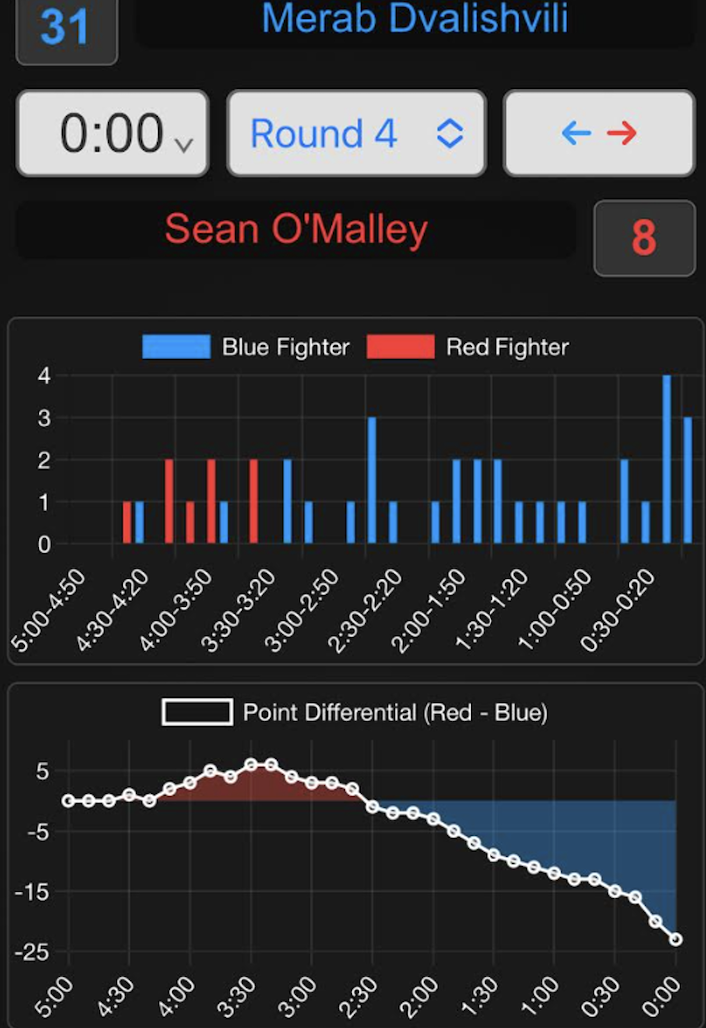
Lingenfelter: The fourth was the most dominant round of the fight. Although the round was dominant, there were no fight-ending sequences that I look for when scoring a 10-8 round. 10-9 Dvalishvili.
ROUND 5
Bronsteter: This was O’Malley’s best round of the fight and it was still something of a narrow margin. O’Malley landed the more impactful offence, did not spend much time on his back and visibly hurt Dvalishvili, stumbling him with a body shot. 10-9 O'Malley; 48-47 Dvalishvili overall.
Lingenfelter: Merab starts off the round continuing his dominance with a takedown at 3:36 and landing some more effective knees and ground and pound. After O’Malley gets to his feet he seems to decide to throw caution to the wind and make one last push to win. He lands multiple big impact strikes at 2:29 and 1:30 with body shots getting big reactions from Merab until Merab gets yet another takedown at the end of the round but is not enough to make up for the earlier effective striking from O’Malley. 10-9 O'Malley; 48-47 Dvalishvili overall.
CONCLUSION
This is one of those fights where the correct fighter won, but the eye test makes the margin feel wider than it actually was based on the “10-point must” system. Realistically, O’Malley is two or three good strikes in the first round away from potentially stealing this fight on the scorecards.
The tricky thing about the optics of fights is that one fighter can look like they have run away with the win, but in reality each round is scored individually using a strict criteria where a fighter who wins two dominant, slam dunk rounds can narrowly lose the other three. That was not the case here, but it was ultimately not a far cry.
To answer the initial question of whether the fight was closer than people remember it being is slightly nuanced. Yes, if you break this fight down round-by-round, there are three relatively close rounds and two dominant rounds for one fighter. In these circumstances, the pendulum could swing to O’Malley by the slightest of margins for those three rounds and Dvalishvili dominates the other two. Those are the decisions that are most often referred to as “robberies”.
Had O’Malley won Round 1, Round 3 and Round 5 on the scorecards, there would be wholesale outrage and I would understand it. The first, while somewhat close, should be scored for Dvalishvili, but it does go to show the difficulty that judges must encounter when scoring fights in real time.
The judges score each round individually, hand in their scorecard and move on to the next round. Their goal is to treat each round like its own entity and not keep track of how they scored the rounds prior, whereas the viewing public and commentary team are keeping close tabs on how they personally have tallied the score to that point.
Had this fight been scored under the old PRIDE FC scoring system, where the judges select an overall winner at the end of the fight and do not score round-by-round, this fight goes to Dvalishvili without question, but when you are scoring round-by-round, it adds a layer of complexity because what the judges see differs greatly from the public because of how beholden they are to scoring it by the letter of the criteria outlined in the unified rules of MMA.
When you parse the MMA Judge Analyzer data from the five rounds, my tally ended up being 101-69 for Dvalishvili, which is a fairly wide margin. However, if I had given O’Malley just three more points in the opening round (I gave Dvalishvili 18 MMA Judge Analyzer points compared to 16 for O'Malley), then I’d have scored both the opening round and the fight for O'Malley despite Dvalishvili having a hypothetical 101-72 advantage overall after 25 minutes.
While judges do not use these sorts of computations when they actually score fights live, it does show that a fighter can look way ahead of another fighter optically and still lose a decision because of how rounds are tallied under the 10-point system.
(To access Lingenfelter’s MMA judging tool, you can visit his mmajudgeanalyzer website.)