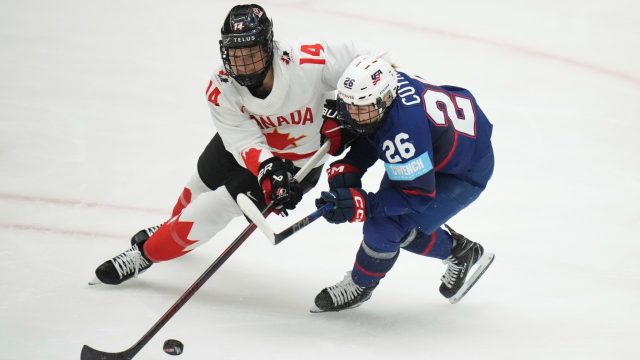
Nine months after the world’s top women’s hockey players met in Milan, we’re about to get another dose of best-on-best competition as the 2026 women’s world championship gets underway in Denmark on Friday.
The tournament is typically held in the spring, but now gets November billing for the first time. Placing the tournament just ahead of the upcoming PWHL season not only jump-starts excitement for a new pro campaign and gets players in top form fast, but it also ensures the season isn’t interrupted by an international break as it has been through the league's first few seasons.
That key date change is an interesting story in itself — how, if at all, might the November tournament hard-launch the game’s best into another year?
The players will surely be ready, and so will we. To help prepare you for the tournament, we’ve assembled some key dates and top storylines to watch ahead of this year’s women’s worlds, with a focus on Team Canada’s overhauled roster.
Key dates
The 2026 women’s world championship runs from Nov. 6-16, with elimination games beginning Nov. 13. Round-robin play will see the tournament’s 10 competing nations divided into two groups, with top-ranked Team USA headlining Group A (which includes Czechia, Switzerland, Germany, and Austria) and Canada favoured to win Group B (which includes Finland, Sweden, Japan, and Denmark).
Canada’s preliminary-round schedule is as follows (all times ET):
Friday, Nov. 6: Sweden @ Canada, 9 a.m.
Sunday, Nov. 8: Canada @ Japan, 1 p.m.
Monday, Nov. 9: Denmark @ Canada, 1 p.m.
Wednesday, Nov. 11: Canada @ Finland, 9 a.m.
Medal round:
Friday, Nov. 13: Quarter-finals
Sunday, Nov. 15: Semi-finals
Monday, Nov. 16: Gold-medal final
Tournament storylines
With Poulin still sidelined, Canada takes committee approach to captaincy
For the first time since her senior international debut in 2009, Marie-Philip Poulin won’t be suiting up for Team Canada at the women’s worlds. Her absence is no surprise, as the 35-year-old is recovering from off-season knee surgery that will also see her sit out at least part of the upcoming PWHL season. Poulin first injured her knee at the Milan Olympics, and later revealed she’d played through a torn ACL and meniscus while helping lead the Montreal Victoire to the Walter Cup this past spring. She underwent surgery in July.
While there is no shortage of leadership on this roster, Poulin’s absence will be felt both on the ice and in the dressing room. The biggest question is this: What does Team Canada look like without its fearless leader?
No single player can replace what Poulin brings to her nation’s squad — she’s "Captain Clutch" for a reason, as we all know — and the same can be said for her leadership. Poulin has worn the captain’s "C" on her sweater for more than a decade. In her place, veterans Laura Stacey and Renata Fast will co-captain the squad in Denmark while Kristin O’Neill will serve as alternate captain.
As Hockey Canada explained in the captaincy announcement last month, Fast will don the "C" when Canada wears red, and Stacey will do so when the team wears white.
About those sweaters…
Chris Johnston of The Athletic reported that Team Canada and Team USA won’t be wearing their usual national team threads in Denmark, and will instead hit the ice in IIHF-provided sweaters due to an ongoing commercial rights dispute.
Hockey Canada provided a statement on the matter Wednesday:
Canada opens new chapter with revamped roster and management team
Canada’s new look extends far beyond their uniforms, of course, as Poulin’s (temporary) absence is not the only big change on this world championship roster. Fellow veteran mainstays like Brianne Jenner, Jocelyne Larocque, Sarah Nurse, Natalie Spooner, Emerance Maschmeyer, Blayre Turnbull, and Claire Thompson are also not on this year’s roster, owing to a variety of reasons. (Nurse revealed she’s dealing with a back injury; Turnbull announced her first pregnancy back in June; Thompson recently retired from pro hockey to return to medical school.)
Watching Canada’s veteran-heavy squad in Milan felt like we were witnessing the end of a chapter. While the team was one overtime winner away from claiming gold against the Americans, Canada often struggled to keep pace with their American foes. Team USA’s dominant performances throughout the Olympic Games thrust a new wave of young, fast talent under the bright Olympic spotlight, and had many questioning why Canada didn’t try to incorporate a little more youth into their Olympic entry, with so much talent of their own knocking at the door.
There was always going to be at least a little bit of turnover as one Olympic cycle came to a close and another four-year wind-up officially opened, but the post-Milan overhaul has been significant. It started in the spring when GM Gina Kingsbury and head coach Troy Ryan stepped down, and continued into the summer and fall when Danièle Sauvageau and Kori Cheverie were announced as their respective replacements.
Already, the early results of those changes can be found on the world championship roster revealed last month — a group that welcomes seven new players making their senior international debuts, with a particularly heavy dose of offence injected into the lineup.
Forwards Caitlin Kraemer, Sara Manness, Rosalie Tremblay, Hayley McDonald, Sarah Wozniewicz, and Rebecca Leslie and defender Kendall Cooper were all named to Canada’s senior national team for the first time — but they aren’t the only fresh faces here.
Chloe Primerano, who made her debut at last year’s worlds but was (somewhat surprisingly) a late cut from the Olympic squad, isn’t a true rookie on this team, but she is widely considered the face of Canada’s next wave of elite talent. Goaltender Eve Gascon was also part of Canada’s 2025 Worlds roster, but didn’t play. Primerano and Gascon are also two of six Team Canada players still in college. Defender Nicole Gosling was left off last year’s world championship squad after appearing in seven games the year prior, and is now back on the roster. Veteran forward Jessie Eldridge has spent just one year with Team Canada, back in 2021-22, and now gets another shot to unleash her offensive talents on the world stage.
Can Team USA maintain the top spot?
The team we saw hit the ice in Milan in February was about as dominant a squad as we’ve even seen in women’s hockey, and they topped off a tremendous Olympic performance with a gold medal to show for it.
The team we’re about to see in Denmark will look plenty familiar — 20 players suiting up at the worlds were on the roster in Milan. Like Team Canada, there are some notable absences. Veteran and former captain Kendall Coyne Schofield announced ahead of the roster reveal she’s pregnant with her second child. Forward Britta Curl-Salemme is expecting her first. Jesse Compher and Lacey Eden both return to the national team after being left off the Milan roster, while three players will debut at the senior level: forward Casey O’Brien, defender Emma Peschel, and goalie Callie Shanahan. There’s some familiarity among the rookies — all three happen to be teammates on the PWHL’s New York Sirens.
In addition to winning Olympic gold in February, Team USA also lands in Denmark as this tournament’s defending champs. The Americans edged Canada in overtime last year in Czechia, after Canada did the same to them in Utica the season prior. The last four years have seen the cross-border rivals take turns standing atop the women’s worlds podium. Defending their title this month would break that pattern and make clear to their Canadian rivals that they won’t give up the top spot easily.
Will Czechia and Finland square off for bronze again?
Czechia was at the centre of the women’s hockey world last year as the nation hosted the women’s world championship for the first time. It was a fitting spotlight, considering the growth of their national program — Czechia won its first-ever women’s worlds medal in 2022 with a bronze victory, and followed it up with another the year after. The nation contended for third in each of the past two years, but both times fell to Finland in a final that ended in a shootout in 2024 and in overtime in 2025. Can they get back on the podium this year?
Neither team made it past the quarter-final at the Milan Olympics, with Finland falling to Switzerland and Sweden topping Czechia. Switzerland ultimately claimed bronze in overtime at the Games, also bumping up their international ranking in the process.
Despite not medalling in Milan, Czechia remains the third-ranked team in IIHF pre-tournament rankings by a slim margin, followed by Switzerland, Finland, and Sweden.



 4:04


 2:00